The blog post explores how class and gender relations are negotiated and reproduced in urban Chinese marriage markets, centring in major Chinese cities. China’s traditional marriage markets – known as xiangqingjiao (相亲角) – are common events in many cities nationwide and across South and Southeast Asia. The phenomenon can also be observed in other well-known Chinese cities such as Nanjing, Chongqing, or Beijing. In the following, I argue that parental matchmaking practices function as exchanges of economic, cultural, and social capital, exposing the typically hidden logics of (heterosexual) homogamy and social reproduction. Mothers are portrayed as key figures bearing a disproportionate burden of emotional and organisational labour, while also navigating significant stigmas related to “leftover” men and women, within a setting of imbalanced sex ratios and rapid changes of modernisation.
By comparing Chinese public marriage markets with algorithmic partner selection and educational homogamy in Western societies, the blog post argues that China is not an exception but a clear example of global patterns linking love, class, and gender in urban cities.
Over the past fifty years, the People’s Republic of China (PRC) has experienced significant societal and economic shifts. These changes are linked to restructuring initiatives aimed at the Chinese demographics and social policies. To sum up, China has experienced two rapid transformations: a demographic decline characterized by decreasing fertility and marriage rates, and an economic shift from a planned to a market-driven economy. Driven by institutional reforms and continuous economic development, more young Chinese are pursuing higher education and focusing on prosperity and careers. The dynamic city of e.g. Shanghai exemplifies this transformation like no other megacity—over three decades, it has become home not only to local residents but also to an increasing number of migrant workers and international and domestic companies, all contributing to the city’s vibrant life with a strong colonial history. The Opium War in 1842 transformed Shanghai into different foreign concessions, and extraterritorially allowed these colonial powers to govern their enclaves independently of Chinese law, leaving behind architectural and social changes that continue to shape the city today.
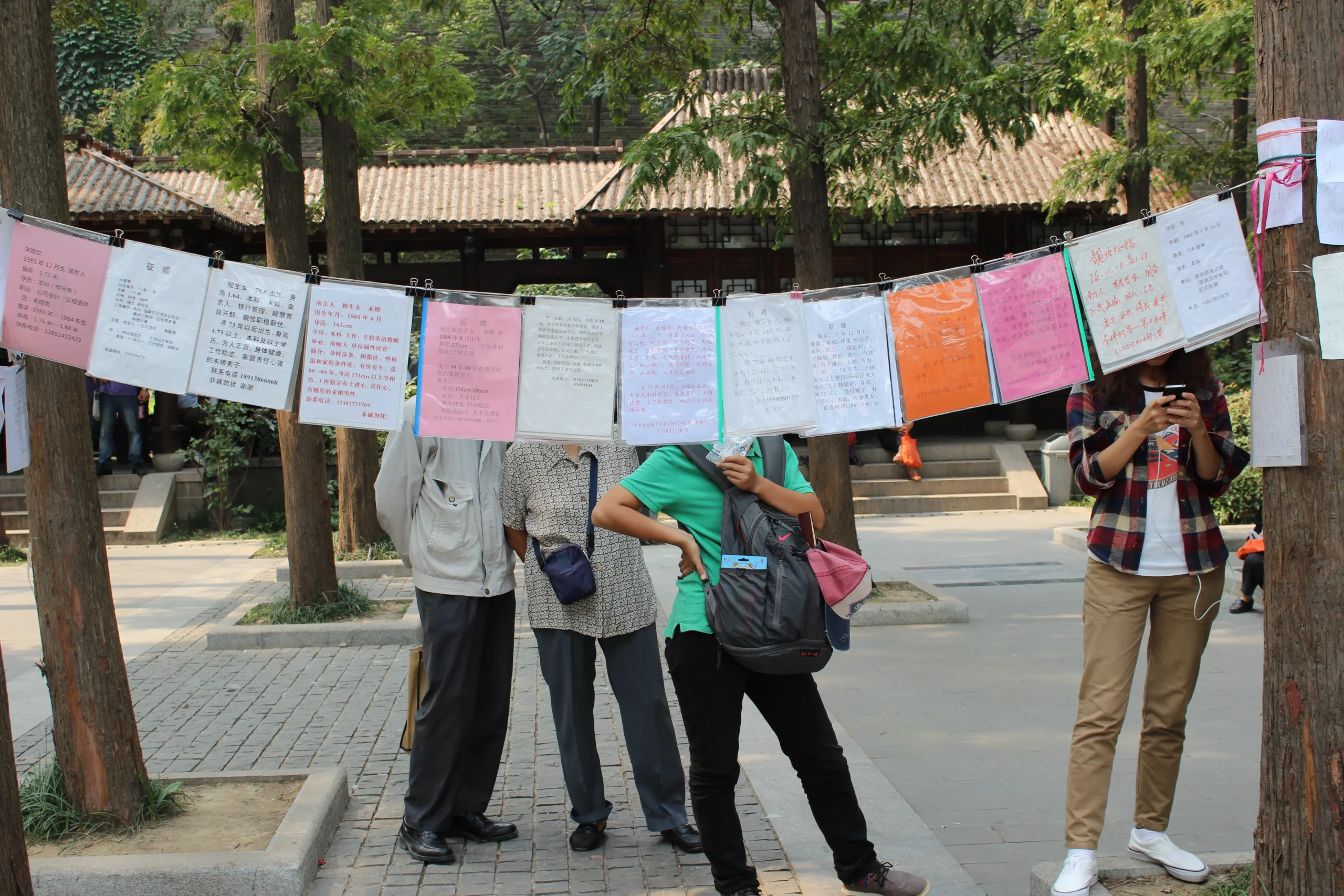
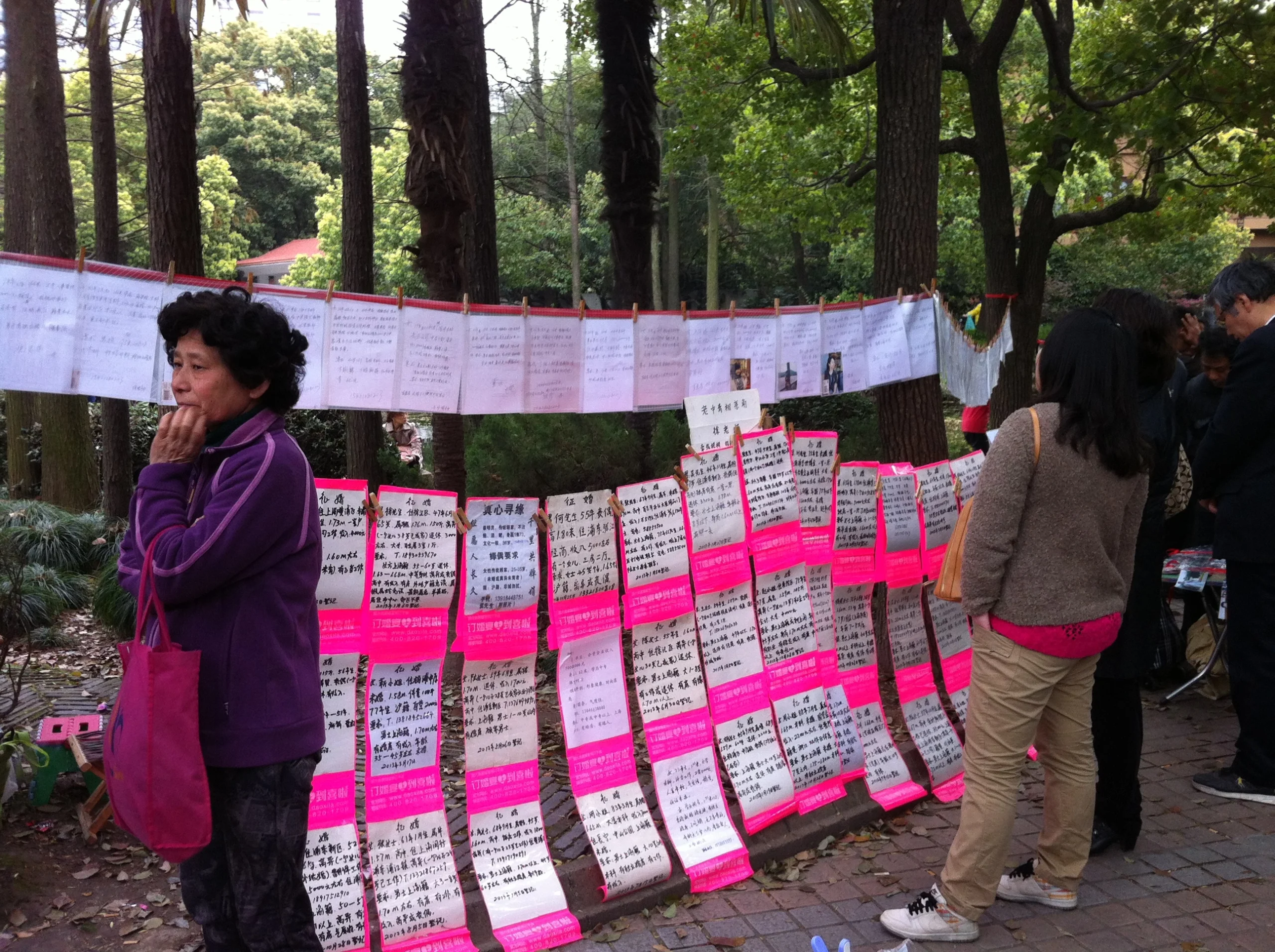
On a Sunday afternoon in People’s Square Park in Shanghai, hundreds of parents gather, while people come to watch the lively scene. They read notes — small, laminated cards hanging from umbrellas or spread out on the ground, covered with numbers, years, and square metres of prospective apartments. Age: 30. Annual income: 400,000 RMB. Apartment: available. Hukou (the Chinese household registration system): urban. Yet anyone who reads those cards immediately recognises an implicit logic that far exceeds romantic feelings. Profiles rarely inquire about hobbies or favourite films and food. The currency of the market is capital, in the most literal sociological sense.
Written ads, Nanjing. Photo: Yvonne Berger.
The Logic of Marketization: Capital, Habitus, and Social Reproduction
Pierre Bourdieu argued that societies reproduce themselves without anyone explicitly planning it (Bourdieu, 1984). People do not marry by chance. Statistically, they marry within their social class — not because they are calculating, but because their habitus, their deeply internalised dispositions, of who “belongs” with whom, draws these boundaries precisely. The marriage market in People’s Square makes visible what otherwise remains invisible: it records those dispositions on pieces of paper. In respect of social class, a notable level of general class consciousness is evident among the Chinese population. Social belonging is a common topic on television, newspapers, and official government programmes. Class consciousness here does not correspond to what Karl Marx understood as the middle class, namely, a group that is largely insignificant in the class struggle. Instead, it is conceived as an initially loose, everyday-life category in China, within which growing perceptions of cultural and social differences among the middle classes are seen as a fundamental precondition for the transmission of forms of capital in Bourdieu’s sense.
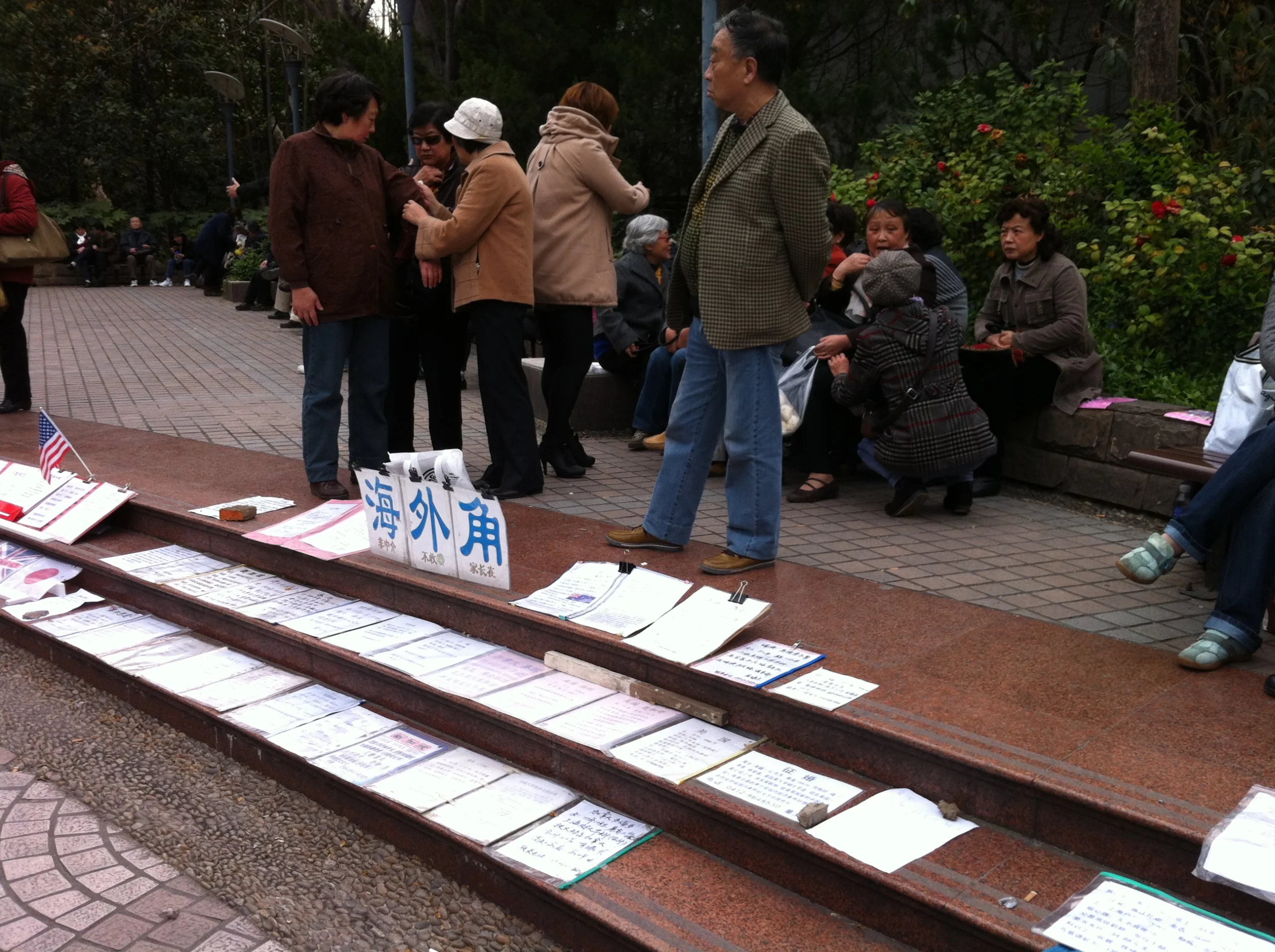
“Overseas corner”, People’s Park Shanghai. Photo: Yvonne Berger.
Moreover, in everyday discourses, the so-called working class is paradoxically expected to avoid being left behind while simultaneously not being part of the functional elites in an anticipated process of capitalist modernization. Here, being “left behind” is a common discourse in everyday China, especially in the context of education. Income, education and hukou are forms of capital that are traded and compared (Toft & Jarness, 2021). An apartment in Jing’an, Shanghai, is worth more than one in Baoshan. A degree from Fudan University carries more weight than one from a provincial college. The market even maintains its own “overseas zone”, where parents of children with international experience gather separately.
Following Bourdieu’s idea that shared capital and similar habitus bring people closer, increasing the likelihood of falling in love (Atkinson, 2024), the park simply makes explicit what elsewhere functions through taste and aesthetic affinity. Marriage markets are not part of a global trend reflected in divorce rates or partnership figures. They are an interesting phenomenon when looking at general statistics: In 2024, the global divorce rate was about 1.6 per 1,000 people. Early 2025 data indicate a slow ongoing decline in both marriage and divorce rates across many regions. Countries like India, Vietnam, Sri Lanka, Peru, and South Africa have some of the lowest divorce rates worldwide. According to Statista Research Department, 59% of people in Germany are in a relationship or married, compared to 63% in Great Britain, 63% in Brazil, and around 49- 50% in the USA and South Africa (ages 18–64). Interestingly, South Africa and the US have high numbers of singles, while in China, 81% of respondents are married – the highest share among major economies surveyed — yet marriage rates in urban centres are declining, and divorce rates in cities like Beijing and Shanghai can approach 40 percent (Wang & Guo, 2024). Furthermore, the global online dating sector is expanding, with revenues anticipated to reach significant levels by 2026, driven by urbanisation and changing cultural attitudes (Statista Research Department, 2025). These figures indicate not the decline of marriage as an institution, but its continuous renegotiation amidst rapid social change.
The notion of romantic love, which often results in marriage and family, creates compatibility conflicts with the biographical realities of later generations in the so-called global cities (Sassen, 2006), despite the rise of dating services, changing cultural values, and the increasing rate of non-marriage cohabitation (Zhou, 2022; Wang & Kan, 2021).
“Overseas corner”, People’s Park Shanghai. Photo: Yvonne Berger
Class Trouble and the Emotional Labour of Mothers: Care, Pressure, and the Sheng Nu/Nan Stigma
Anyone who spends time at the xiangqinjiao notices that it’s frequented almost exclusively by middle-aged parents, predominantly mothers. The children concerned are often absent, and sometimes entirely unaware that their mother is there on their behalf (Fung, 2015). Arlie Hochschild (1989) already demonstrated long ago that emotional labour — the management of feelings, relationships, and social expectations — is unevenly distributed across gender lines and is disproportionately performed by women. At the xiangqinjiao, mothers shoulder an immense burden of care work. They research potential partner matches, make contacts with other parents, and bear the pressure of caring for two generations simultaneously. Their goal is not to undermine their children’s autonomy, but to care for their futures and protect against the risks of poverty, social class decline, and the shengnu/nan stigma that continues to affect unmarried women and men over 30 in contemporary China. Since the male-to-female sex ratio at birth has been rising over the past 30 years, unmarried women and men are today labelled as shengnu or shengnan (剩女/剩男), which literally means “leftover women/men” (To, 2013). This term is primarily used in public discourse about women. Most of the women are well educated and have decent jobs. Conversely, men are forced to provide a high income and an apartment if they wish to succeed as potential husbands. They are named guanggun (光棍), meaning “bare stick”, referring to those who cannot continue the family lineage, especially in rural areas. The deep-rooted structural factors reinforcing those stigmata are significant. Gao et al. (2022) show that from 1996 to 2017, China’s average sex ratio at birth remained above 1.06. About seven out of every hundred Chinese men may not find a marriage partner. The former one-child policy, combined with a cultural preference for sons, created a significant male surplus in rural and lower-income areas. Conversely, in major cities like Shanghai and Beijing, the situation is reversed: highly educated, professionally successful women face a narrower pool of men considered socially “equivalent” according to current market standards. Simultaneously, many young urban Chinese experience a clear tension. They have internalized global ideals of romantic love and personal partner choice, but still face significant family and societal pressure.
Written ads, Nanjing. Photo: Yvonne Berger.
Class Reproduction with Chinese Characteristics? A Comparative Global Perspective
It is overly simplistic to view the xiangqinjiao as solely a Chinese phenomenon. In Europe and the U.S., people predominantly partner within their own educational classes—reflecting a pattern known as assortative mating or educational homogamy, observed in many countries. Recent studies suggest that the educational level is the most significant predictor of partner choice, even more than income, regional origin, or personality (Hirschl et al., 2024). What Western societies hide behind algorithmic “compatibility scores” in online dating and narratives of shared interest is openly displayed on laminated cards in Chinese cities. The park shows us what remains hidden elsewhere, namely that the person we experience as our “perfect match” usually speaks the same language, attended equivalent schools, and holds comparable assets. Similar institutional forms can be found in other East Asian societies dealing with declining fertility and delayed marriage. In Japan, community- and NGO-led matchmaking events called konkatsu (婚活) serve a similar purpose, highlighting regional demographic concerns. The Chinese situation is notable for its scale, public nature, and the way the market becomes a space for shaping a uniquely Chinese modernity.
Glocalization of Class & Gender: Dating in the Age of Global Cities
Over the past fifty years, the People’s Republic of China has experienced multiple social and economic changes. These changes are most evident in cities like Shanghai, which has been a hub for internal migrants, international companies, and globally mobile professionals for the past thirty years. The social landscape here is distinctly “glocal” — deeply rooted in local norms while also influenced by global trends (Khondker, 2004; Robertson, 1995; Sassen, 2006). The quest for romantic partners transcends geographic borders, creating tension between local marriage traditions and globalized dating customs. In major cities, people select partners based on cultural influences but are increasingly driven by international perspectives and digital media, resulting in relationships that are both locally rooted and globally connected. The idea of glocalization explains how local practices evolve, resist, or change under global influence. Urban marriage markets illustrate this interplay: parents still visit the xiangqinjiao while their children use international dating apps; traditional criteria, such as capital compatibility, remain relevant alongside modern aspirations for romantic love. Digital platforms broaden the search for partners but do not eliminate the social pattern of homogamy—they simply extend and accelerate it.
Conclusion
Economic modernization and increased educational mobility have drawn millions of young women and men into China’s cities. Gender roles have shifted significantly: women more often report stronger natal ties and question the traditional patrilineal family model. However, the expectation that a prospective husband provides a marital home demonstrates the continued influence of traditional values even amid deeply changed social circumstances (Zhou & Wang, 2024).
The concept of romantic love, understood as a feeling that naturally leads to marriage and family, often conflicts sharply with the biographical realities of generations living in global cities. Long working hours, high living costs, and career imperatives lead many urban singles to delay marriage and parenthood. The integration of work and personal life is increasingly mediated by technology, as dating applications enable individuals to seek partners whose lifestyles align with their professional commitments.
This is the situation Hochschild diagnosed as the “stalled revolution” (Hochschild, 1989): formal gender equality in education and the labour market has not been accompanied by a commensurate redistribution of care work, domestic labour, or the emotional labour of relationship maintenance. At the xiangqinjiao, the stall is literally embodied in the figure of mothers who search on behalf of a child.
The rise of the shengnu phenomenon further illustrates the paradox: highly educated professional women remain unmarried not from lack of choice, but because they encounter a limited range of partners who meet their educational and professional standards, while simultaneously facing societal pressure that frames their situation as failure (Zhou, 2022). This reflects what Abrahamson (2015) describes as the gendered constraints of changing social landscapes, in which traditional patriarchal norms and modern aspirations for individual achievement meet in productive tension. Chinese marriage markets reveal the underlying logics that are often hidden elsewhere: how capital influences partner choices, the gender-specific division of caregiving and emotional labour, and the balancing act between family duties and personal independence in China.
From a broader sociological perspective, the marriage market in Chinese urban cities offers insights into phenomena that extend beyond China. The dynamics seen at the xiangqinjiao reflect broader trends: when urbanization gathers mobile, educated people into competitive labour markets; when global ideas of romantic love intersect with local class and gender structures; and when family formation is delayed, negotiated, or renegotiated amid economic uncertainty.





Leave a comment