Global sociology from the “metropole”: Alt-Treptow, Berlin

Johannes Becker, Leibniz-Zentrum Moderner Orient
Eight hundred meters, or a ten-minute walk: that is the distance between Marian Burchardt’s apartment and mine in Berlin. Over the past years, we have been coordinating the research network whose blog you are currently reading, and we have more than once joked with others in the network that we are running Global Sociology from a tiny neighborhood in Berlin, Alt-Treptow, with a population of roughly 13,500. But there is something to this joke. Space matters in Global Sociology, and so does positionality. So, what does Alt-Treptow, the little neighborhood where we live, and the fact that we live here, tell us about Global Sociology?
Consider this a small exercise in glocalization – a way of grounding long-term globalization processes in concrete spaces or of exploring the role local spaces have in globalization (Massey, 1994; Robertson, 1995). The result is a Global Sociology of the very local with the aim of emphasizing that Global Sociology is not “simply” about the Global South as the forgotten space of sociology, but it can also be about the many processes that have contributed to making the social world as it is now, with the reproduction of power relations between various regions, the processes of exchange of people, ideas and goods, and the (in)visibility of these processes in everyday life in the Global North.
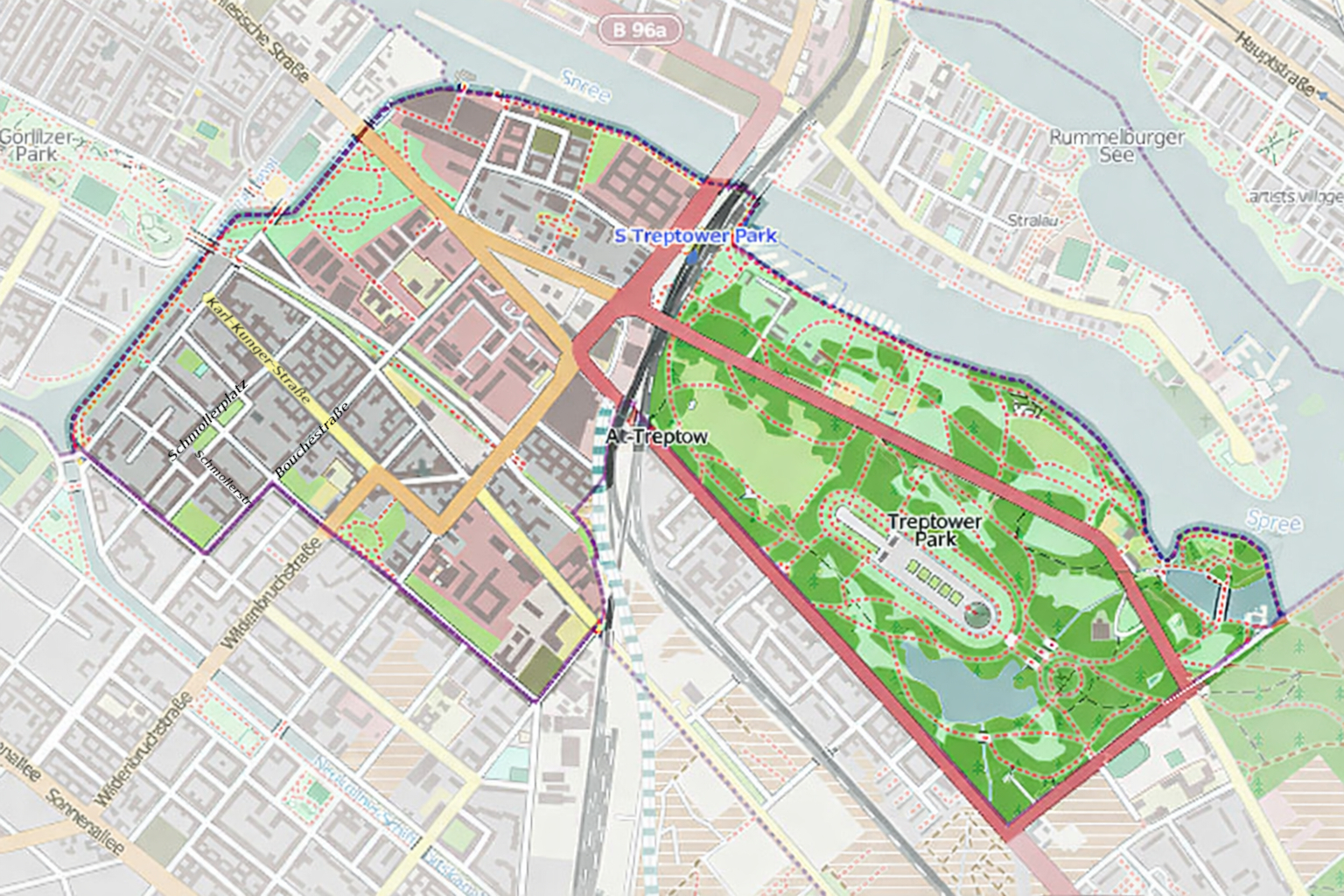
Map of Alt-Treptow and Treptower Park, modified, based on Wikipedia.
Huguenots, Human zoos, global confrontation, gentrification
Marian lives in Bouchéstraße, named after a Huguenot family who arrived in Berlin from Bonnay in the French Champagne in the late seventeenth century, together with roughly 6,000 others who were welcomed to Brandenburg-Prussia after being persecuted during the Catholic Counter Reformation in France, one of many movements of religious refugees at the time. The Huguenots shaped Berlin to an extraordinary extent: before their arrival, the city had about 20–25,000 inhabitants, and the newcomers soon made up around fifteen percent of the population. They were seen as economically skilled and “civilized,” contributing to the city’s development, but also provoking jealousy among long-established Berliners who felt they received undue privileges. Johann Peter Paul Bouché (1759–1846), great-grandson of the first Bouchés in Berlin, was honored with the street name in Alt-Treptow because he transformed nearby land along the river Spree into a horticultural enterprise (“geregelte Anpflanzung von Gehölzen bei Treptow“/ “planned planting of wooded areas in Treptow”) that would later form the grounds of Treptower Park, one of Berlin’s famous green lungs. This very local detail makes it clear that the emerging capital of the German Empire was anything but “purely Germanic.” Yet these origins are largely invisible today, mostly known only to specialists. Even I was unaware of the street name’s history before I started this little investigation.
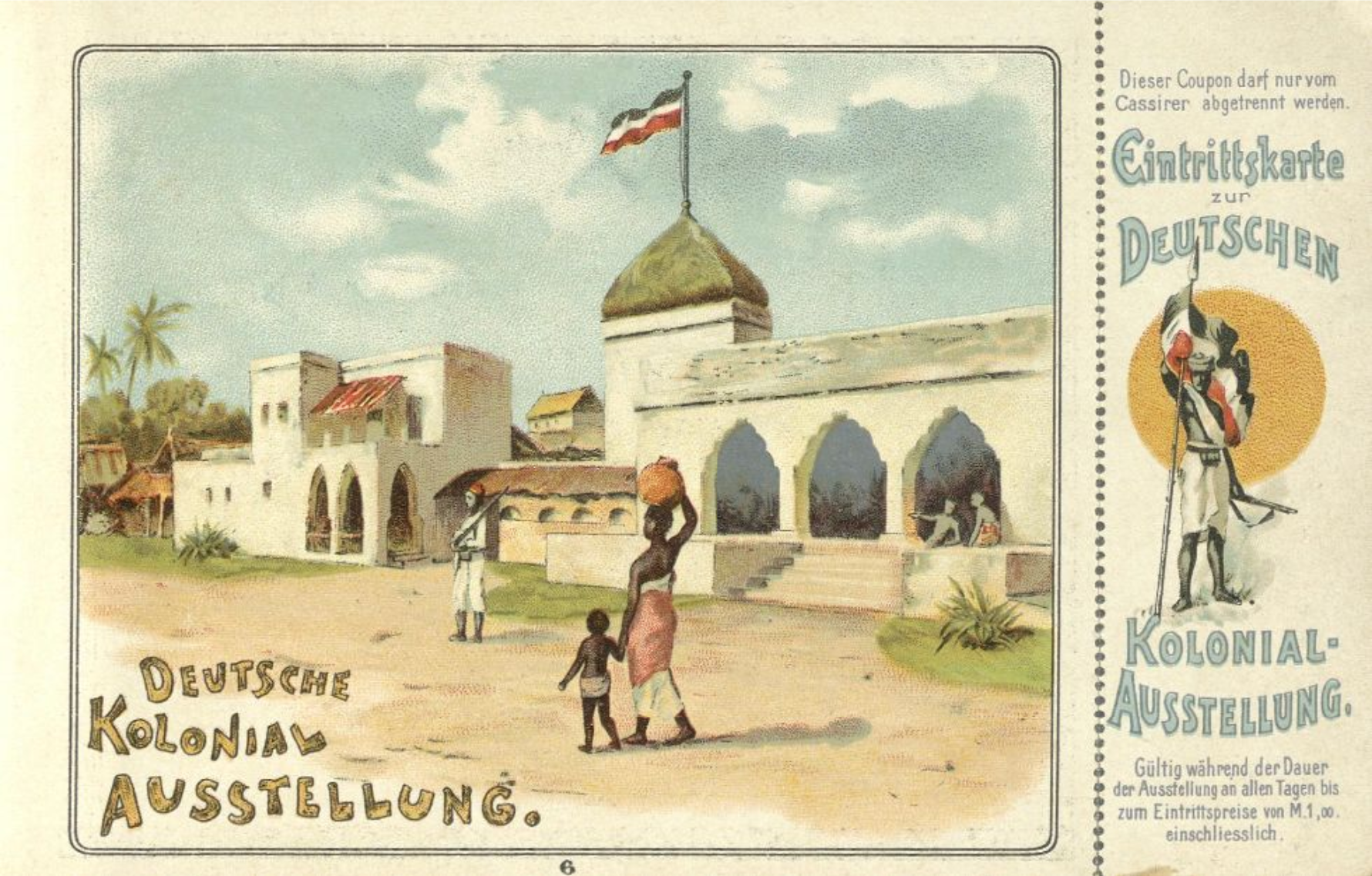
Ticket for the Berliner Kolonialausstellung, available at Digitale Landesbibliothek Berlin
In 1896, the same Treptower Park became the site of the Große Berliner Gewerbeausstellung (Great Industrial Exposition of Berlin), a huge exhibition, the German version of the World’s Fairs that Berlin never officially hosted. Alongside spectacular displays of industrial modernity, the exhibition featured the Berliner Kolonialausstellung (Berlin Colonial Exhibition), and in this frame an “African village” for which families from German colonies were brought to Berlin, 106 persons in total, and asked to perform “authentic” African life. They protested against their poor treatment and the way they were exhibited to the public. Imperial ambitions abroad were tied to a domestic mission: educating the public, here in Alt-Treptow, about the colonies and justifying the supposed “civilizing” efforts of colonial rule. This glorification of colonialism and racism has until recently rarely been acknowledged in the neighborhood’s contemporary historiography. However, since 2021 the local Berlin-Treptow museum has hosted the permanent exhibition titled “zurückgeschaut | looking back.”[1]
The scale of the entire Gewerbeausstellung was enormous. Seven million people visited it, and the event reshaped public transport routes and stations in the urban area, leaving infrastructural traces that constitute an overlooked marker of globalization until today. Much later, after the Second World War, Treptower Park became the site of a vast Soviet war memorial which also serves as a military cemetery. Today this memorial is entangled in ongoing struggles over commemoration, between those who support Putin’s imperial Russia and those who advocate a strong, independent Ukraine, the latter arguing that Russia instrumentalizes the memorial for imperial purposes.
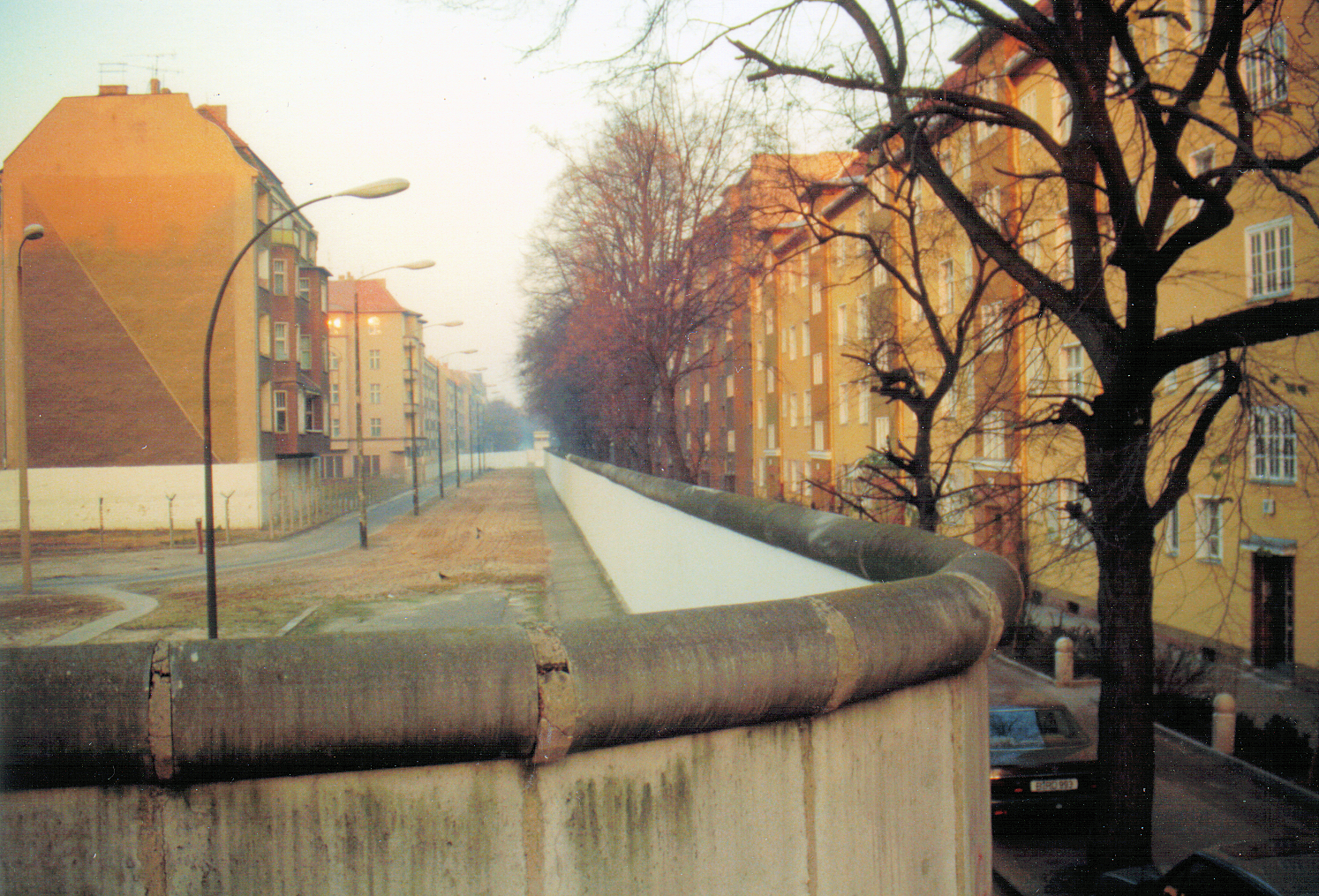
The wall in Bouchéstraße,
available at Wikipedia.
After 13 August 1961, the part of Bouchéstraße where Marian lives was divided by the Berlin Wall. One side belonged to the GDR and the Warsaw Pact, the other to West Berlin, fashioned as a beacon of the “free world,” placing the street at the epicenter of the global confrontation of the period. At the same time, Alt-Treptow was thus located at a dead corner of the city of East Berlin, surrounded by the wall on three sides as can be seen by the purple line on the left side of the map above. Because the wall here lacked the broad death strip found in other parts of the city, making escape routes to the West more easily accessible, the GDR authorities settled families loyal to the regime in many of the houses. Indications of this very localized elite – at least that is how I perceive it – are still noticeable in the neighborhood, often embodied by older men whose habitus hints at a different societal formation, now confronted with the newcomers to Alt-Treptow. This too is a global story. In the past ten to fifteen years construction began where the GDR had cleared land along the wall. Many of the new buildings offer owner-occupied flats, attracting young families. Like the rest of Berlin, Alt-Treptow has been affected by steeply rising costs of living and processes of gentrification; many families can no longer afford the city center and move to the suburbs. Yet in these newly built homes in Alt-Treptow, one finds a striking number of binational and “multicultural” families. For these global families, remaining in an international, liberal, and cosmopolitan city center – with a different vibe than the often more conservative or right-wing areas around Berlin – has particular importance, and the new housing provided an opportunity to do so, even if it means a heavy financial burden.
Surprising connections in the globalization of sociology
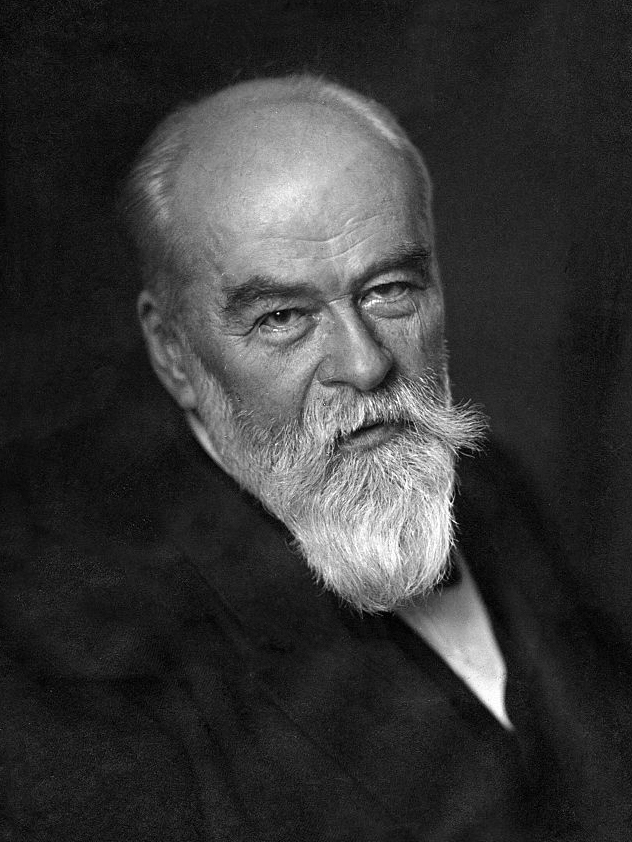
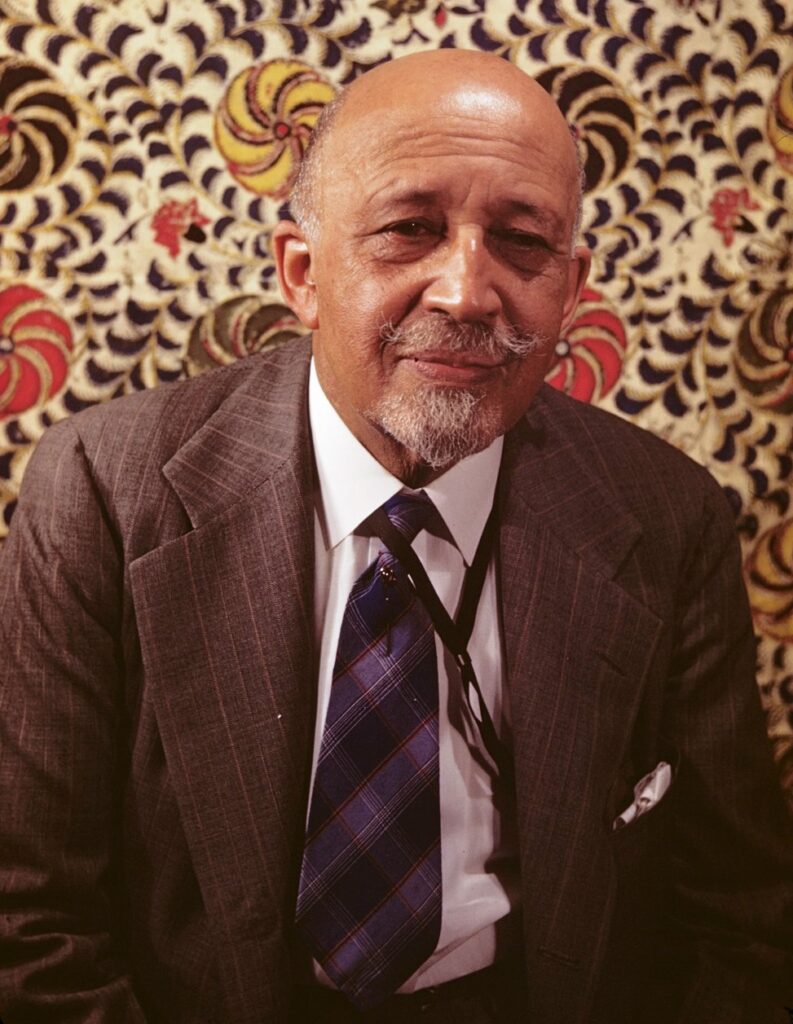
To the left: Gustav von Schmoller, ca. 1908, available at Wikipedia.
To the right: W.E.B. Du Bois, 1946, available at Yale Library.
But this is not the only way to arrive at Global Sociology from Alt-Treptow. Walking the eight hundred meters from Marian’s home to mine in Karl-Kunger-Straße, you can choose among several streets named after nineteenth- and twentieth-century German political economists (Nationalökonomen) such as Wilhelm Lexis, Carl Menger, August Oncken, and Gustav von Schmoller. You will most likely pass Schmollerstraße and Schmollerplatz before entering Karl-Kunger-Straße. Gustav von Schmoller (1838–1917) is arguably the most influential of these economists, and thus he lends his name to both a street and a square. Schmollerplatz is a leafy square, featuring Gründerzeit buildings from the early 20th century, Plattenbau blocks from the GDR and new developments for the affluent.
As an economist, Schmoller was interested not only in the market but also in the “social question,” and although he was not considered “left-wing” at all, he – like several other economists – was given the ironic nickname of Kathedersozialist (variously translated as socialist of the chair, academic socialist or armchair sociologist). By working towards social justice between different classes he wanted to prevent an upcoming socialist revolution. Schmoller became known in sociological circles as a counterpart to Max Weber. In the Verein für Socialpolitik (Association for Social Policy), founded in 1872 in Eisenach – which by coincidence is Marian’s hometown – Schmoller played a central role. He embodied the opposing position to Weber, who in his essay on “The “Objectivity” of Knowledge in Social Science and Social Policy” (published in German in 1904) had demanded that – while not assuming their complete neutrality – scholars should withhold their “value judgments” (Werturteile), their own political orientations, and their convictions over the course of the empirical research process. Schmoller, on the other hand, identified the “common good” as an “objective value judgment.”
Schmoller’s broadly positive attitude toward the German colonial project was fully in line with these positions. He argued that colonialism was essential for Germany’s emergence as a political and economic great power. At the same time, he adopted a comparatively liberal or moderate stance toward colonized populations, whom he believed could be “civilized.” For instance, he advocated “native farming” and “native small businesses” instead of plantation-based economies, seeing these as tools for educating the “natives,” integrating them – at least potentially – into a capitalist world economy, and improving their conditions. In Berlin, he was also among the later founders of the Kolonialpolitisches Aktionskomité (Colonial-Political Action Committee) in 1906 (Grimmer-Solem, 2007). As a respected and widely known public intellectual, he thus helped mobilize broad German public support for the colonial project.
How this thinking affected one of his earlier students is unclear: W.E.B. Du Bois (1868–1963) had enthusiastically attended Schmoller’s lectures at the Friedrich Wilhelm University in Berlin (today’s Humboldt University, which later awarded him an honorary doctorate in 1958). Du Bois lived in Germany from 1892–1894, first in Eisenach and then in Berlin Kreuzberg, at that time a working-class district adjacent to Treptow, in the apartment of a German family roughly three and a half kilometers away.
From today’s vantage point, it is difficult to comprehend that Du Bois found life as a Black man in Berlin considerably more pleasant than in the United States, where, especially in the South, social contact was prohibited. In Berlin, and Germany, as he enthusiastically comments in his autobiography, he experienced greater integration into social contexts, and, above all, perceived that class differences were emphasized more strongly than “racial differences,” and that he was seen as an aspiring student:
So too in brave old Eisenach […] I spent a happy holiday in a home where university training and German home-making left no room for American color prejudice. From this unhampered social intermingling with Europeans of education and manners, I emerged from the extremes of my racial provincialism. I became more human; learned the place in life of “Wine, Women, and Song”; I ceased to hate or suspect people simply because they belonged to one race or color; and above all I began to understand the real meaning of scientific research and the dim outline of methods employing its technique and its results in the new social sciences for the settlement of the Negro problems in America (Du Bois, 1968, p. 160).
At the university in Berlin, Du Bois mainly attended lectures by economists – besides Schmoller also those of Heinrich von Treitschke, a well-known antisemite and nationalist. Du Bois was fascinated by their scholarly work and, in general, also by “militaristic patriotism” in Germany and – as Cahn (2025) argues – seems to have ignored Treitschke’s antisemitism just as he overlooked broader misanthropic tendencies in Germany. Academically, Du Bois was impressed by the then-hegemonic historical approach in German political economy, because it enabled him to understand the situation of Black Americans using historical methods and in a globally comparative manner.
He was likewise impressed by the engagement of Schmoller and the Kathedersozialisten with the social question: although conservative in many respects, they expressed clear positions on the challenges of social inequality in Germany, including taking part in the debates in the public sphere. Du Bois became a member of the aforementioned Verein für Socialpolitik, which, according to Cahn (2025), would later inspire his activist commitments.
While Schmollerstraße and Schmollerplatz were named after the economist in 1930 and are well known in Alt-Treptow where many streets bear the names of “great” political economists, Du Bois was only honored in 2019 with a commemorative plaque on the wall of the Kreuzberg house he lived in.
How does it matter today? …and for us
Working through the neighborhood described here on the basis of historical processes as well as historical names and references of course triggers the question: What is this good for, is it in any way relevant for Global Sociology besides being an entertaining exercise?
That is a question that is difficult to answer without in-depth empirical investigation, something that is, of course, not possible within the scope of this short text. The historical density of urban space always allows for a multiplicity of historically specific interpretations, only a few of which are ever discussed discursively, become relevant in people’s socialization, and solidify as interpretive patterns. This is also subject to historical change (Massey, 1995). Moreover, it is always a question of what is perceived latently and what is “known” as explicit knowledge.
As someone interested in history, I was not aware of Bouché’s story, nor do I think much about Schmoller when I pronounce the name of the square, even though I know who he was. The small explanatory plaques attached to the street signs do not change this. What is most present to me is the former division of Bouchéstraße into “East” and “West,” and the effects of this on the social fabric of the neighborhood up to the present day. I write this from the position of the “finite province of meaning” in the everyday world (following Schütz, 1962), i.e. as someone who lives there but has not studied this neighborhood academically.
What drew us to Alt-Treptow? This is best explained by the district’s existence on the dividing line between the western and eastern global spheres of influence until 1990, and the resulting tucked-in position of the neighborhood, bordered on three sides by “the West.” To this day, this tends to evoke associations of a village-like, family-friendly character compared with the surrounding neighborhoods. The other aspects mentioned in this text were more peripheral at the time – and yet they are important when one adopts a more scholarly approach to one’s own positioning within urban space.
[1] First opened in 2017, see Museumsportal Berlin.
Cite this article as: Becker, J. (2026, February 12). Global sociology from the “metropole”: Alt-Treptow, Berlin. Global Qualitative Sociology Network. https://global-qualitative-sociology.net/2026/02/12/global-sociology-from-the-metropole/
References
Du Bois, W. E. B. (2007). The autobiography of W.E.B. Du Bois: A soliloquy on viewing my life from the last decade of its first century (H. L. Gates, Ed.). Oxford University Press. (Original work published 1968)
Grimmer-Solem, E. (2007). The professors’ Africa: Economists, the elections of 1907, and the legitimation of German imperialism. German History, 25(3), 313–347. https://doi.org/10.1177/0266355407079905
Massey, D. (1994a). A global sense of place. In Space, place and gender (pp. 146–156). Polity Press.
Massey, D. (1994b). Space, place and gender. Polity Press.
Massey, D. (1995). Places and their pasts. History Workshop Journal, 39(1), 182–192. https://doi.org/10.1093/hwj/39.1.182
Robertson, R. (1995). Glocalization: Time-space and homogeneity-heterogeneity. In R. Robertson & S. Lash (Eds.), Global modernities (pp. 25–44). Sage Publications.
Schutz, A. (1962). On multiple realities. In A. Schutz, Collected Papers I (Vol. 11, pp. 207–259). Springer Netherlands. https://doi.org/10.1007/978-94-010-2851-6_9
Weber, M. (1904). Die ‘Objektivität’ sozialwissenschaftlicher und sozialpolitischer Erkenntnis. Archiv Für Sozialwissenschaft Und Sozialpolitik, 19(1), 22–87.