Johannes Becker, Leibniz-Zentrum Moderner Orient
Eight hundred meters, or a ten-minute walk: that is the distance between Marian Burchardt’s apartment and mine in Berlin. Over the past years, we have been coordinating the research network whose blog you are currently reading, and we have more than once joked with others in the network that we are running Global Sociology from a tiny neighborhood in Berlin, Alt-Treptow, with a population of roughly 13,500. But there is something to this joke. Space matters in Global Sociology, and so does positionality. So, what does Alt-Treptow, the little neighborhood where we live, and the fact that we live here, tell us about Global Sociology?
Consider this a small exercise in glocalization – a way of grounding long-term globalization processes in concrete spaces or of exploring the role local spaces have in globalization (Massey, 1994; Robertson, 1995). The result is a Global Sociology of the very local with the aim of emphasizing that Global Sociology is not “simply” about the Global South as the forgotten space of sociology, but it can also be about the many processes that have contributed to making the social world as it is now, with the reproduction of power relations between various regions, the processes of exchange of people, ideas and goods, and the (in)visibility of these processes in everyday life in the Global North.
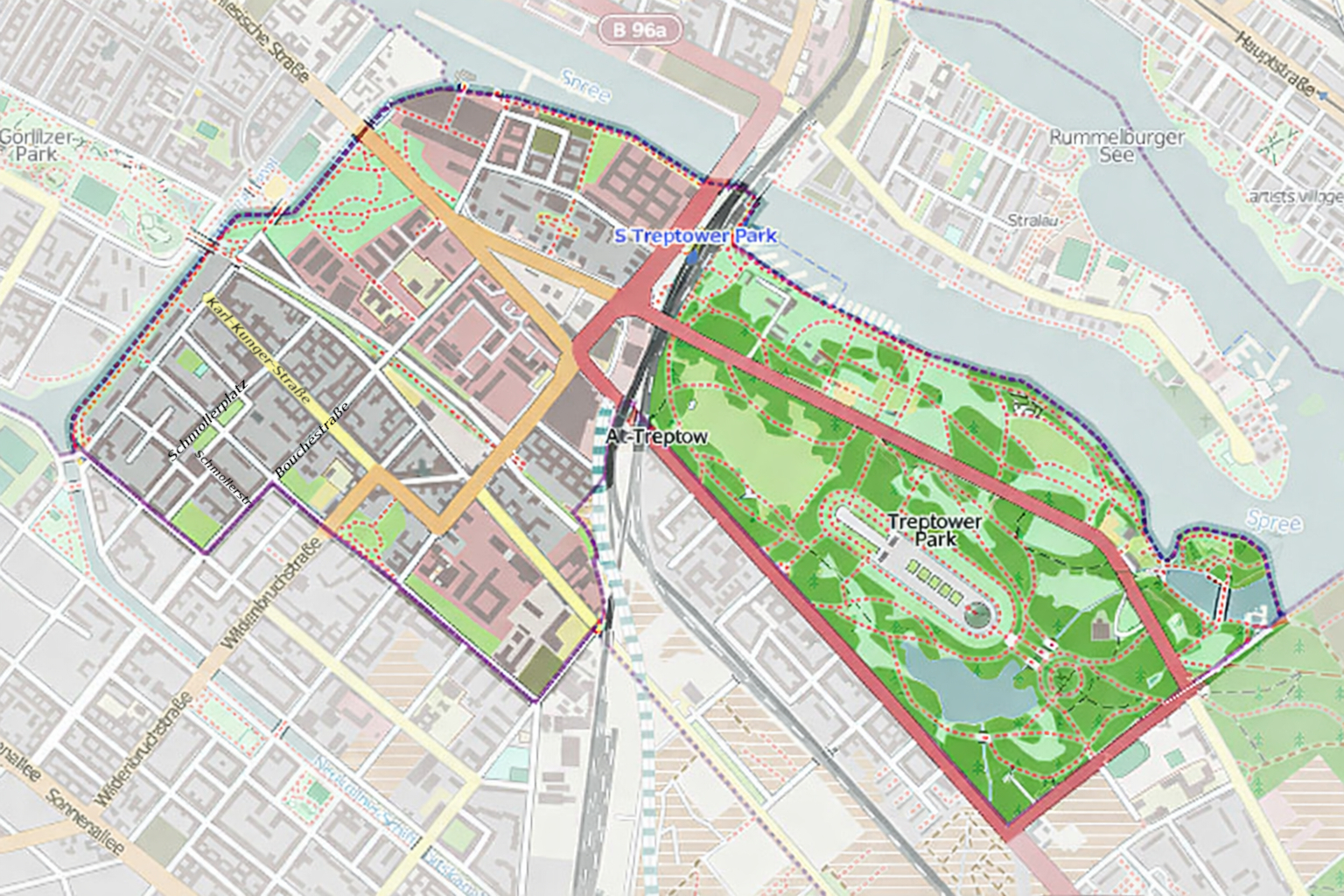
Map of Alt-Treptow and Treptower Park, modified, based on Wikipedia.
Huguenots, Human zoos, global confrontation, gentrification
Marian lives in Bouchéstraße, named after a Huguenot family who arrived in Berlin from Bonnay in the French Champagne in the late seventeenth century, together with roughly 6,000 others who were welcomed to Brandenburg-Prussia after being persecuted during the Catholic Counter Reformation in France, one of many movements of religious refugees at the time. The Huguenots shaped Berlin to an extraordinary extent: before their arrival, the city had about 20–25,000 inhabitants, and the newcomers soon made up around fifteen percent of the population. They were seen as economically skilled and “civilized,” contributing to the city’s development, but also provoking jealousy among long-established Berliners who felt they received undue privileges. Johann Peter Paul Bouché (1759–1846), great-grandson of the first Bouchés in Berlin, was honored with the street name in Alt-Treptow because he transformed nearby land along the river Spree into a horticultural enterprise (“geregelte Anpflanzung von Gehölzen bei Treptow“/ “planned planting of wooded areas in Treptow”) that would later form the grounds of Treptower Park, one of Berlin’s famous green lungs. This very local detail makes it clear that the emerging capital of the German Empire was anything but “purely Germanic.” Yet these origins are largely invisible today, mostly known only to specialists. Even I was unaware of the street name’s history before I started this little investigation.
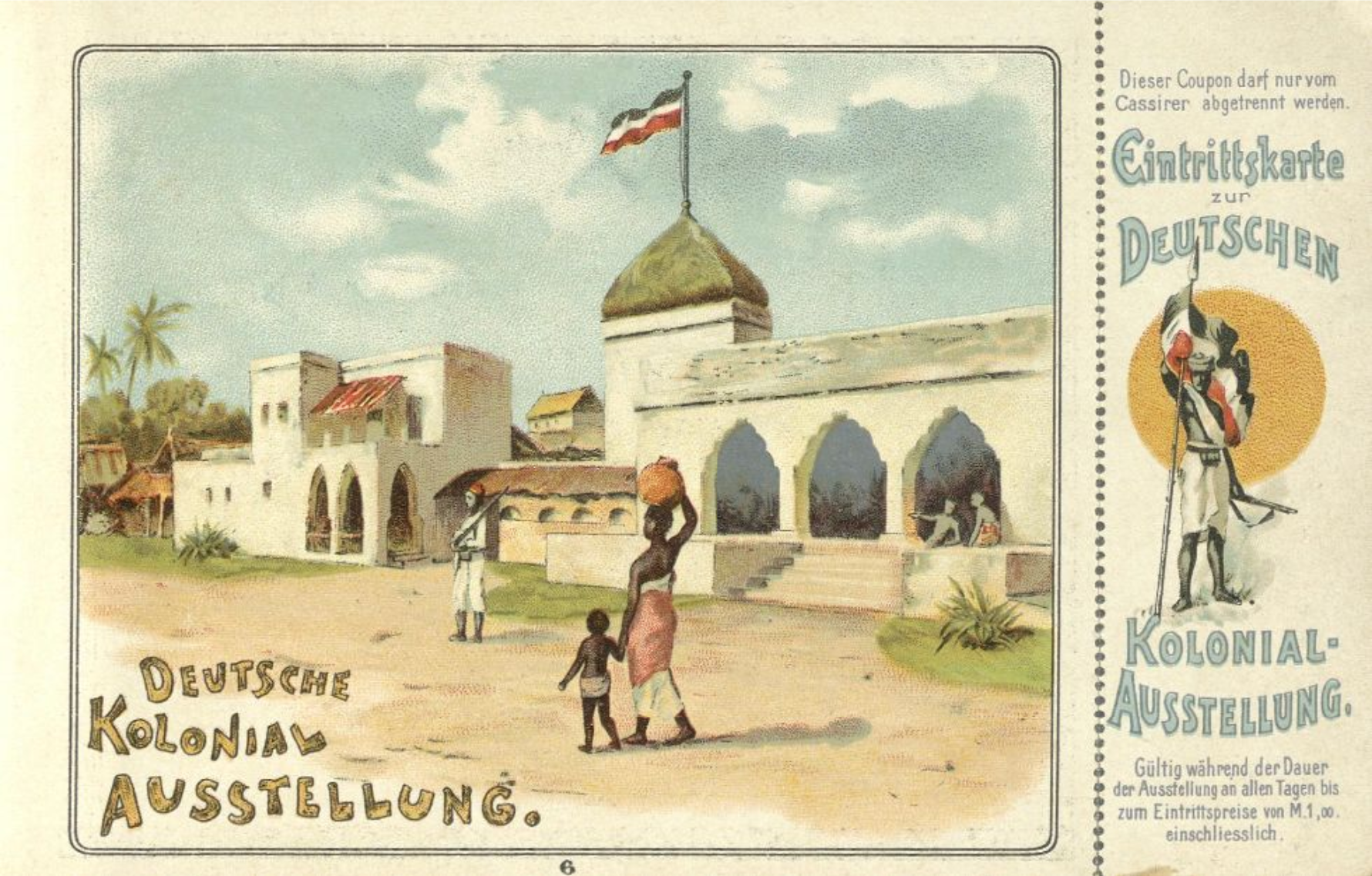
In 1896, the same Treptower Park became the site of the Große Berliner Gewerbeausstellung (Great Industrial Exposition of Berlin), a huge exhibition, the German version of the World’s Fairs that Berlin never officially hosted. Alongside spectacular displays of industrial modernity, the exhibition featured the Berliner Kolonialausstellung (Berlin Colonial Exhibition), and in this frame an “African village” for which families from German colonies were brought to Berlin, 106 persons in total, and asked to perform “authentic” African life. They protested against their poor treatment and the way they were exhibited to the public. Imperial ambitions abroad were tied to a domestic mission: educating the public, here in Alt-Treptow, about the colonies and justifying the supposed “civilizing” efforts of colonial rule. This glorification of colonialism and racism has until recently rarely been acknowledged in the neighborhood’s contemporary historiography. However, since 2021 the local Berlin-Treptow museum has hosted the permanent exhibition titled “zurückgeschaut | looking back.”[1]
The scale of the entire Gewerbeausstellung was enormous. Seven million people visited it, and the event reshaped public transport routes and stations in the urban area, leaving infrastructural traces that constitute an overlooked marker of globalization until today. Much later, after the Second World War, Treptower Park became the site of a vast Soviet war memorial which also serves as a military cemetery. Today this memorial is entangled in ongoing struggles over commemoration, between those who support Putin’s imperial Russia and those who advocate a strong, independent Ukraine, the latter arguing that Russia instrumentalizes the memorial for imperial purposes.
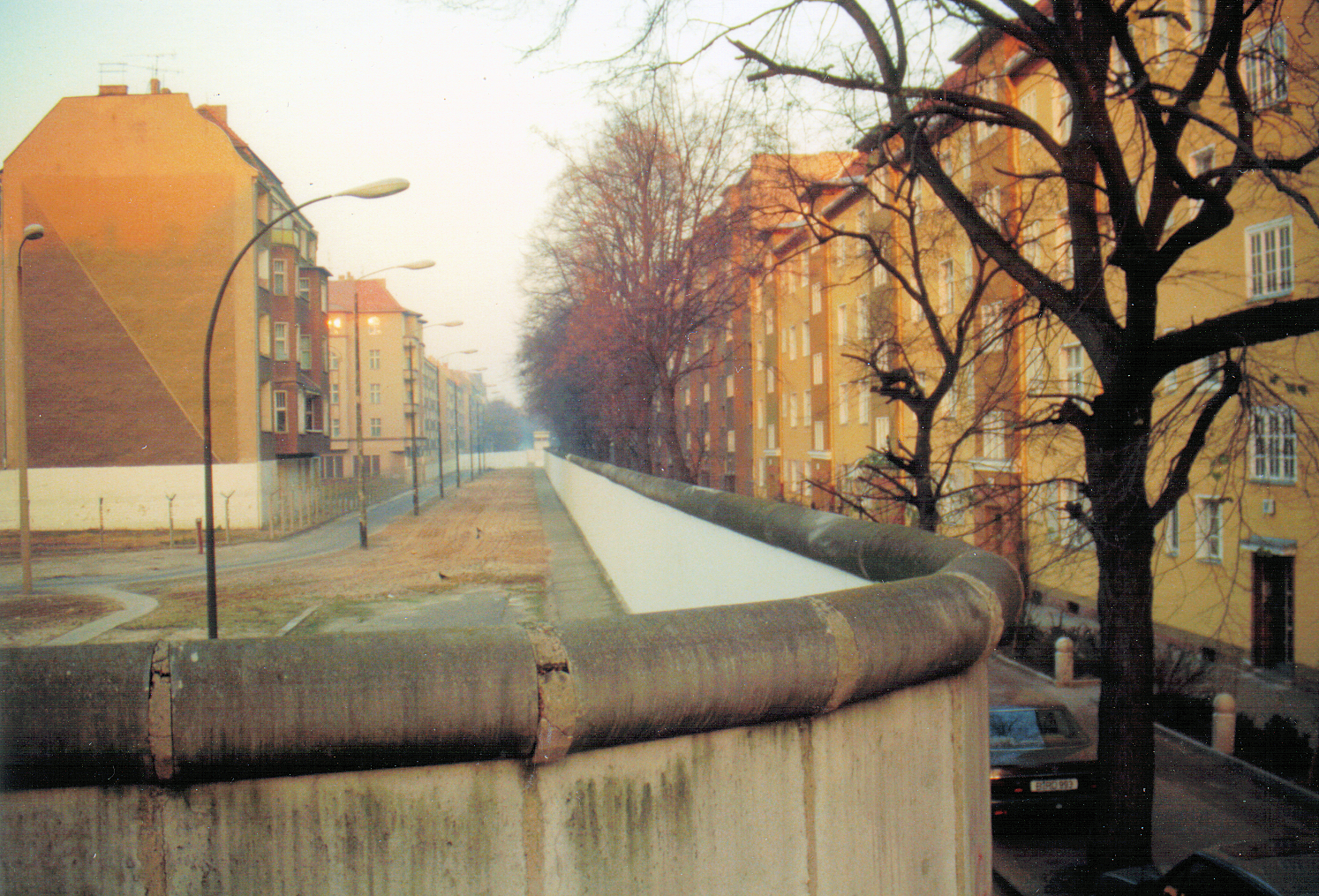
The wall in Bouchéstraße,
available at Wikipedia.
After 13 August 1961, the part of Bouchéstraße where Marian lives was divided by the Berlin Wall. One side belonged to the GDR and the Warsaw Pact, the other to West Berlin, fashioned as a beacon of the “free world,” placing the street at the epicenter of the global confrontation of the period. At the same time, Alt-Treptow was thus located at a dead corner of the city of East Berlin, surrounded by the wall on three sides as can be seen by the purple line on the left side of the map above. Because the wall here lacked the broad death strip found in other parts of the city, making escape routes to the West more easily accessible, the GDR authorities settled families loyal to the regime in many of the houses. Indications of this very localized elite – at least that is how I perceive it – are still noticeable in the neighborhood, often embodied by older men whose habitus hints at a different societal formation, now confronted with the newcomers to Alt-Treptow. This too is a global story. In the past ten to fifteen years construction began where the GDR had cleared land along the wall. Many of the new buildings offer owner-occupied flats, attracting young families. Like the rest of Berlin, Alt-Treptow has been affected by steeply rising costs of living and processes of gentrification; many families can no longer afford the city center and move to the suburbs. Yet in these newly built homes in Alt-Treptow, one finds a striking number of binational and “multicultural” families. For these global families, remaining in an international, liberal, and cosmopolitan city center – with a different vibe than the often more conservative or right-wing areas around Berlin – has particular importance, and the new housing provided an opportunity to do so, even if it means a heavy financial burden.
Surprising connections in the globalization of sociology
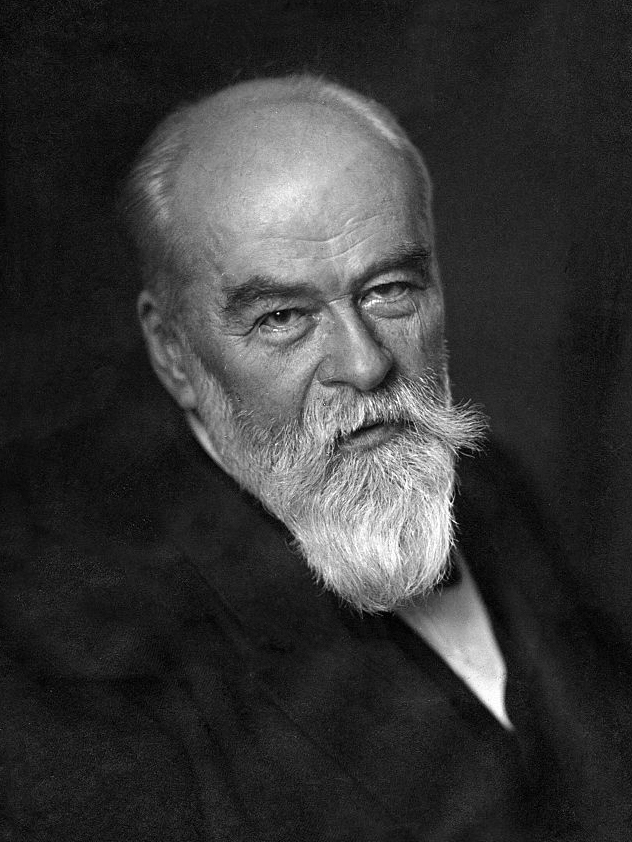
To the left: Gustav von Schmoller, ca. 1908, available at Wikipedia.
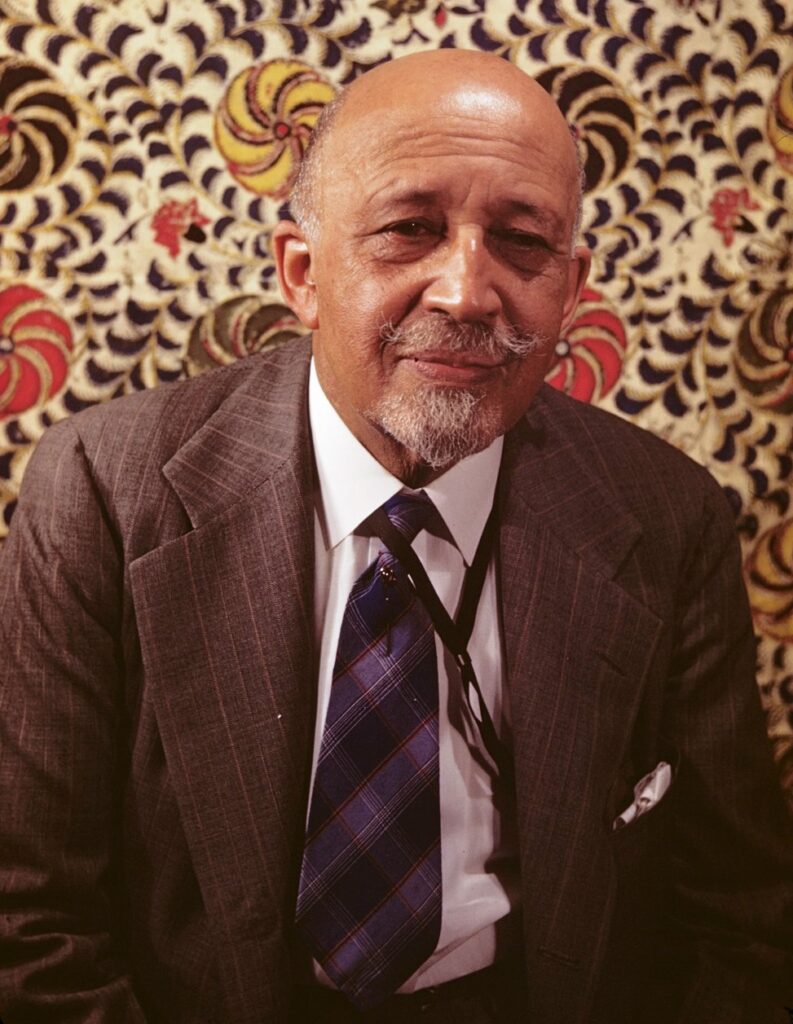
To the right: W.E.B. Du Bois, 1946, available at Yale Library.
But this is not the only way to arrive at Global Sociology from Alt-Treptow. Walking the eight hundred meters from Marian’s home to mine in Karl-Kunger-Straße, you can choose among several streets named after nineteenth- and twentieth-century German political economists (Nationalökonomen) such as Wilhelm Lexis, Carl Menger, August Oncken, and Gustav von Schmoller. You will most likely pass Schmollerstraße and Schmollerplatz before entering Karl-Kunger-Straße. Gustav von Schmoller (1838–1917) is arguably the most influential of these economists, and thus he lends his name to both a street and a square. Schmollerplatz is a leafy square, featuring Gründerzeit buildings from the early 20th century, Plattenbau blocks from the GDR and new developments for the affluent.
As an economist, Schmoller was interested not only in the market but also in the “social question,” and although he was not considered “left-wing” at all, he – like several other economists – was given the ironic nickname of Kathedersozialist (variously translated as socialist of the chair, academic socialist or armchair sociologist). By working towards social justice between different classes he wanted to prevent an upcoming socialist revolution. Schmoller became known in sociological circles as a counterpart to Max Weber. In the Verein für Socialpolitik (Association for Social Policy), founded in 1872 in Eisenach – which by coincidence is Marian’s hometown – Schmoller played a central role. He embodied the opposing position to Weber, who in his essay on “The “Objectivity” of Knowledge in Social Science and Social Policy” (published in German in 1904) had demanded that – while not assuming their complete neutrality – scholars should withhold their “value judgments” (Werturteile), their own political orientations, and their convictions over the course of the empirical research process. Schmoller, on the other hand, identified the “common good” as an “objective value judgment.”
Schmoller’s broadly positive attitude toward the German colonial project was fully in line with these positions. He argued that colonialism was essential for Germany’s emergence as a political and economic great power. At the same time, he adopted a comparatively liberal or moderate stance toward colonized populations, whom he believed could be “civilized.” For instance, he advocated “native farming” and “native small businesses” instead of plantation-based economies, seeing these as tools for educating the “natives,” integrating them – at least potentially – into a capitalist world economy, and improving their conditions. In Berlin, he was also among the later founders of the Kolonialpolitisches Aktionskomité (Colonial-Political Action Committee) in 1906 (Grimmer-Solem, 2007). As a respected and widely known public intellectual, he thus helped mobilize broad German public support for the colonial project.
How this thinking affected one of his earlier students is unclear: W.E.B. Du Bois (1868–1963) had enthusiastically attended Schmoller’s lectures at the Friedrich Wilhelm University in Berlin (today’s Humboldt University, which later awarded him an honorary doctorate in 1958). Du Bois lived in Germany from 1892–1894, first in Eisenach and then in Berlin Kreuzberg, at that time a working-class district adjacent to Treptow, in the apartment of a German family roughly three and a half kilometers away.
From today’s vantage point, it is difficult to comprehend that Du Bois found life as a Black man in Berlin considerably more pleasant than in the United States, where, especially in the South, social contact was prohibited. In Berlin, and Germany, as he enthusiastically comments in his autobiography, he experienced greater integration into social contexts, and, above all, perceived that class differences were emphasized more strongly than “racial differences,” and that he was seen as an aspiring student:
So too in brave old Eisenach […] I spent a happy holiday in a home where university training and German home-making left no room for American color prejudice. From this unhampered social intermingling with Europeans of education and manners, I emerged from the extremes of my racial provincialism. I became more human; learned the place in life of “Wine, Women, and Song”; I ceased to hate or suspect people simply because they belonged to one race or color; and above all I began to understand the real meaning of scientific research and the dim outline of methods employing its technique and its results in the new social sciences for the settlement of the Negro problems in America (Du Bois, 1968, p. 160).
At the university in Berlin, Du Bois mainly attended lectures by economists – besides Schmoller also those of Heinrich von Treitschke, a well-known antisemite and nationalist. Du Bois was fascinated by their scholarly work and, in general, also by “militaristic patriotism” in Germany and – as Cahn (2025) argues – seems to have ignored Treitschke’s antisemitism just as he overlooked broader misanthropic tendencies in Germany. Academically, Du Bois was impressed by the then-hegemonic historical approach in German political economy, because it enabled him to understand the situation of Black Americans using historical methods and in a globally comparative manner.
He was likewise impressed by the engagement of Schmoller and the Kathedersozialisten with the social question: although conservative in many respects, they expressed clear positions on the challenges of social inequality in Germany, including taking part in the debates in the public sphere. Du Bois became a member of the aforementioned Verein für Socialpolitik, which, according to Cahn (2025), would later inspire his activist commitments.
While Schmollerstraße and Schmollerplatz were named after the economist in 1930 and are well known in Alt-Treptow where many streets bear the names of “great” political economists, Du Bois was only honored in 2019 with a commemorative plaque on the wall of the Kreuzberg house he lived in.
How does it matter today? …and for us
Working through the neighborhood described here on the basis of historical processes as well as historical names and references of course triggers the question: What is this good for, is it in any way relevant for Global Sociology besides being an entertaining exercise?
That is a question that is difficult to answer without in-depth empirical investigation, something that is, of course, not possible within the scope of this short text. The historical density of urban space always allows for a multiplicity of historically specific interpretations, only a few of which are ever discussed discursively, become relevant in people’s socialization, and solidify as interpretive patterns. This is also subject to historical change (Massey, 1995). Moreover, it is always a question of what is perceived latently and what is “known” as explicit knowledge.
As someone interested in history, I was not aware of Bouché’s story, nor do I think much about Schmoller when I pronounce the name of the square, even though I know who he was. The small explanatory plaques attached to the street signs do not change this. What is most present to me is the former division of Bouchéstraße into “East” and “West,” and the effects of this on the social fabric of the neighborhood up to the present day. I write this from the position of the “finite province of meaning” in the everyday world (following Schütz, 1962), i.e. as someone who lives there but has not studied this neighborhood academically.
What drew us to Alt-Treptow? This is best explained by the district’s existence on the dividing line between the western and eastern global spheres of influence until 1990, and the resulting tucked-in position of the neighborhood, bordered on three sides by “the West.” To this day, this tends to evoke associations of a village-like, family-friendly character compared with the surrounding neighborhoods. The other aspects mentioned in this text were more peripheral at the time – and yet they are important when one adopts a more scholarly approach to one’s own positioning within urban space.
References
Du Bois, W. E. B. (2007). The autobiography of W.E.B. Du Bois: A soliloquy on viewing my life from the last decade of its first century (H. L. Gates, Ed.). Oxford University Press. (Original work published 1968)
Massey, D. (1994a). A global sense of place. In Space, place and gender (pp. 146–156). Polity Press.
Massey, D. (1994b). Space, place and gender. Polity Press.
Weber, M. (1904). Die ‘Objektivität’ sozialwissenschaftlicher und sozialpolitischer Erkenntnis. Archiv Für Sozialwissenschaft Und Sozialpolitik, 19(1), 22–87.

On post-truth, conspiracy theories, and the majority world
By Joschka Philipps, University of Bayreuth
“Post-truth,” defined as “relating to circumstances in which objective facts are less influential in shaping public opinion than appeals to emotion and personal belief” (Flood, 2016), has attracted substantial attention, and lament, in public discourse and within the discipline of sociology (Aradau & Huysmans, 2019; Ball, 2017; Drążkiewicz & Harambam, 2024; Fuller, 2018; Hess, 2020). Twelve years before the term gained notoriety as the 2016 Oxford Dictionary’s Word of the Year, the late Bruno Latour argued in 2004 that the weapons of critical theory had fallen into the hands of ludicrous conspiracy theorists. “What has become of critique,” Latour (2004, p. 228) asked, “when my neighbor in the little Bourbonnais village where I live looks down on me as someone hopelessly naïve because I believe that the United States had been attacked by terrorists [on 9/11]?” And then:
Let me be mean for a second. What’s the real difference between conspiracists and a popularized […] version of social critique inspired by a too quick reading of, let’s say, a sociologist as eminent as Pierre Bourdieu […]? In both cases, you have to learn to become suspicious of everything people say because of course we all know that they live in the thralls of a complete illusio of their real motives. Then, after disbelief has struck and an explanation is requested for what is really going on, in both cases again it is the same appeal to powerful agents hidden in the dark acting always consistently, continuously, relentlessly. Of course, we in the academy like to use more elevated causes—society, discourse, knowledge-slash-power, fields of forces, empires, capitalism—while conspiracists like to portray a miserable bunch of greedy people with dark intents, but I find something troublingly similar in the structure of the explanation, in the first movement of disbelief and, then, in the wheeling of causal explanations coming out of the deep dark below. What if explanations resorting automatically to power, society, discourse had outlived their usefulness and deteriorated to the point of now feeding the most gullible sort of critique? (p. 228).
Faced with existential concerns like climate change, Latour was hard-pressed to assure readers that his earlier work on the denaturalization of scientific facts (e.g., Latour, 1987) “was never to get away from facts but closer to them, not fighting empiricism but, on the contrary, renewing empiricism” (2004, p. 231). The point, he argued, was that matters of fact “are not all that is given in experience” and “only very partial”; a more suitable focus in the social sciences should be on more holistic matters of concern, which aim to construct, protect and to care rather than to debunk (2004, p. 232).
Steve Fuller trenchantly critiques such “fancy metaphysical diversions” as deflecting attention “from the naked power dynamics” that inhere in knowledge production and have long stood in the way of “greater epistemic democracy” (Fuller, 2018, pp. 61-62). Academics and intellectuals, instead of trying to reclaim their destabilized epistemic authority by morally defaming post-truth and conspiracy theorists, should see the contemporary post-truth condition as marking “a triumph of democracy over elitism, albeit one that potentially tilts the balance towards ‘chaos’ over ‘order’” (Fuller, 2018, p. 181).
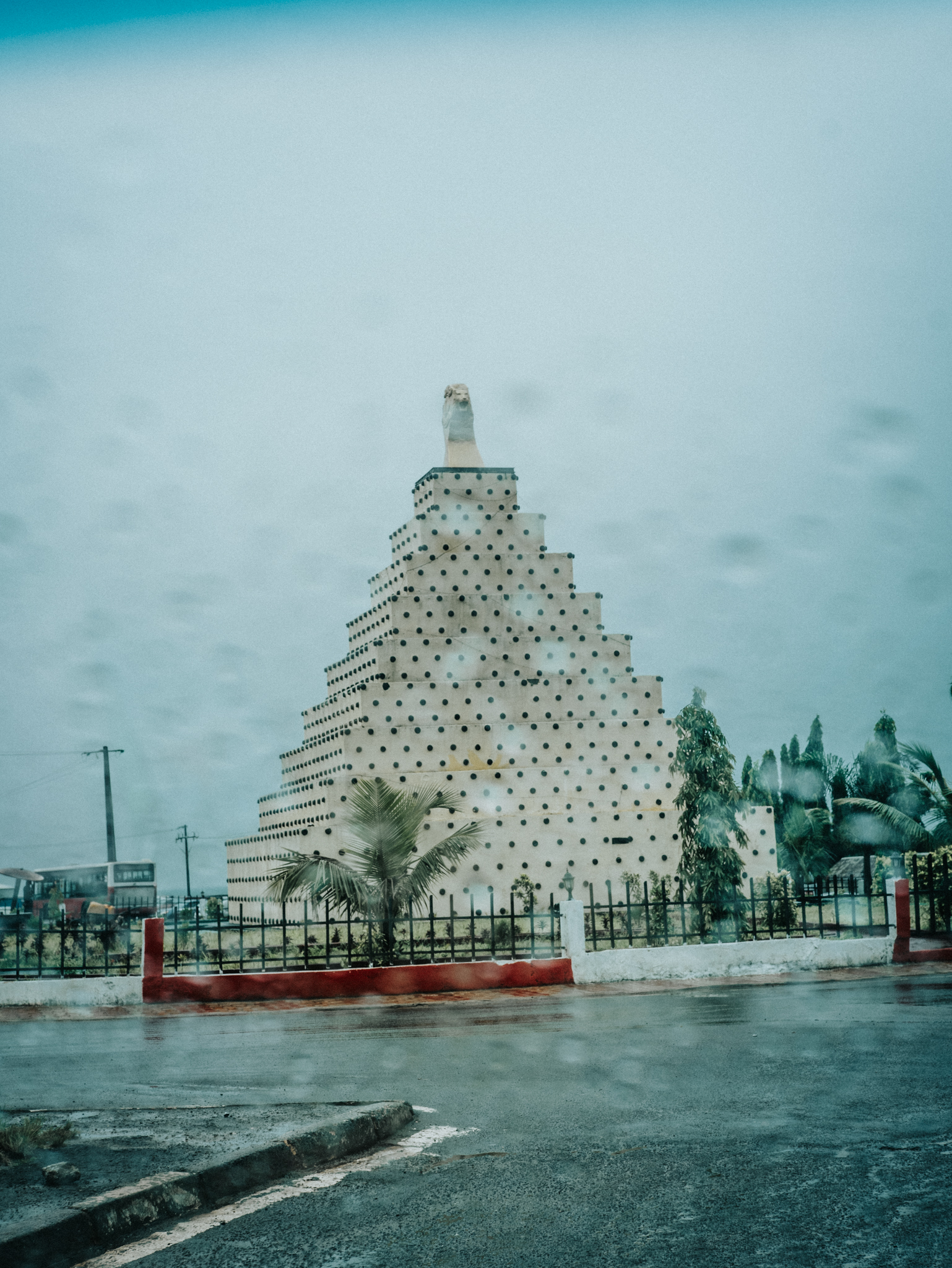
Pyramide. Photo: Courtesy of Aurélien Gillier.
Whatever side one takes in these “Science Wars,” Fuller’s (2018) point “that the post-truth condition is here to stay” (p. 181) is hard to refute. It brings to the fore what sociologists have previously conceptualized as the “contingency” (Wagner-Pacifici, 2000) or as the “radical uncertainty” (Boltanski, 2011, p. 37) that underlies society and that now is turning into a very concrete lifeworld experience. This constitutes something radically new in places where the nation-state has long fulfilled the task of “organizing and unifying reality, or, as sociology puts it today, of constructing reality, for a given population on a given territory” (Boltanski, 2014, p. x). In the majority world, however, (or the “global south” or “postcolonial contexts,” however you want to call it), the post-truth condition has long been present. As Ahmed Veriava (2025) has put it succinctly, “For the colonized, reality has always been post-truth,” both in terms of a skeptical distance to the academy—usually deemed in cahoots with power—and in terms of an exceedingly pluralistic epistemic lifeworld, in which no single institution can legitimately claim authority over the Truth. An analogy between the city of Conakry and the Internet might help undergird my point. Whether one immerses oneself in the capital of the Republic of Guinea or in the boundless heterogeneity of information circulating online, one might easily experience “a lack of gravity that would hold meanings to specific expressions and actions. There are no bearings and disorientation is guaranteed. Yet the crisis is dissipated: there is no normality to refer to” (Simone, 2008, p. 30).
The question of normality brings us back to the conspiracy theories that concerned Latour, and which, in the moral panic over an alleged post-truth era, have become a central boogey man (Aradau & Huysmans, 2019; Drążkiewicz & Harambam, 2024). Conspiracy theories strike a chord with earlier, and arguably foundational questions around ideology and false consciousness in Marxism, various strands of critical theory and in the sociology of knowledge (Collins, 1998, p. 1034). As such, they are not only the pathologized “other,” against which scientific disciplines acclaim their methodological rigor and scientificity (cf. Douglas et al., 2019; Hofstadter, 1964; Popper, 1962); they also constitute an alter ego, a style of thought in which “we recognize something of ourselves” (Carey, 2017, p. 94; see also Boltanski, 2011, 2014; Dentith, 2019; Orr & Husting, 2019; Parker, 2000). This intriguing tension may explain the ever-growing popularity of conspiracy theories as a research topic—as evidenced by the 112 page-long bibliography of the COMPACT research project (“Comparative analysis of conspiracy theories in Europe”) and the increase in academic interest in conspiracy theories—in just 1 year, from 2020 to 2021, psychological studies on conspiracy beliefs have multiplied by 150%, according to Bowes et al. (2023, p. 2).
In the global north, conspiracy theories are usually interpreted as a form of heterodoxy (Anton et al., 2014), i.e., as antithetical to the “normal” doxa of mainstream opinion. One influential definition of a conspiracy theory sees it as an “accusatory perception which may or may not be true, and usually conflicts with the appropriate authorities” while “conspiracy refers to events that our appropriate institutions have determined to be true” (Uscinski, 2019, p. 48; emphasis in the original). The concern here is not about the factuality of whether a conspiracy has happened; it is about whether the epistemic authorities say that it has happened. Such an interpretation presumes the existence of such authorities, and their sufficient authority and legitimacy to institutionalize a clear dividing line between ortho-or heterodoxy. But this line is increasingly difficult to draw, anywhere in the world, given the “multiplication of coexisting interpretations of reality” (Schnettler, 2018, p. 231, with reference to Peter Berger). Moreover, it has not been the norm in many postcolonial contexts of the majority world, which instead have been accustomed to a far greater indeterminacy of reality (Cooper & Pratten, 2015; Mbembe, 2001; Newell, 2012). In such contexts, there can be no “conspiracy theory” in the Western sense of the term (Philipps & Gillier, 2024). Indeed, when Oumarou Boukari was doing research on Covid-19 conspiracy theories in neighboring Côte d’Ivoire, only very few of his research participants would understand what he meant by “conspiracy theory.” To explain, he ended up translating the term by asking “whether people thought the coronavirus was politics” (Boukari & Philipps, 2023, p. 115, my emphasis). As a synonym for politics, conspiracy theories in the majority world are neither heterodox nor stigmatized, but simply one way amongst others of highlighting the Machiavellian nature of power and domination.
The Don Killuminati
Indeed, if there is one political theorist whose name popped up regularly in my conversations with urban youth in Conakry, it’s Machiavelli. Or perhaps it’s Makavelli, the US rapper Tupac Shakur’s artist’s name on his posthumous album “The Don Killuminati: The 7 Day Theory” (1996). In Conakry, Tupac remains a central icon to this day; his likeness adorns bars, hair salons, minibuses, and T-shirts like in no other Francophone capital in West Africa. The son of Black Panthers activist Afeni Shakur, Tupac spoke out with a vengeance against the oppression and manipulation of black minorities in the US, including by the corrupt music industry (Stanford, 2011). He took his alias after having read Machiavelli’s The Prince in prison in 1994, while making clear that “My name is not Machiavelli, my name is Makaveli. I took it, that’s mine. […] And I don’t feel no guilt. All these motherfuckers stole from us forever, I’m taking back what’s mine.“ Tupac’s indictment of “the system” still resonates with Conakry’s self-proclaimed ghetto youth (Philipps, 2013) in different ways. And although he was critical of the idea of an Illuminati global conspiracy—“I’m putting the K [be]cause I’m killing that Illuminati shit”—the album title “The Don Killuminati” contributed to the Illuminati’s popularity in the global rap scene, and also in Conakry.
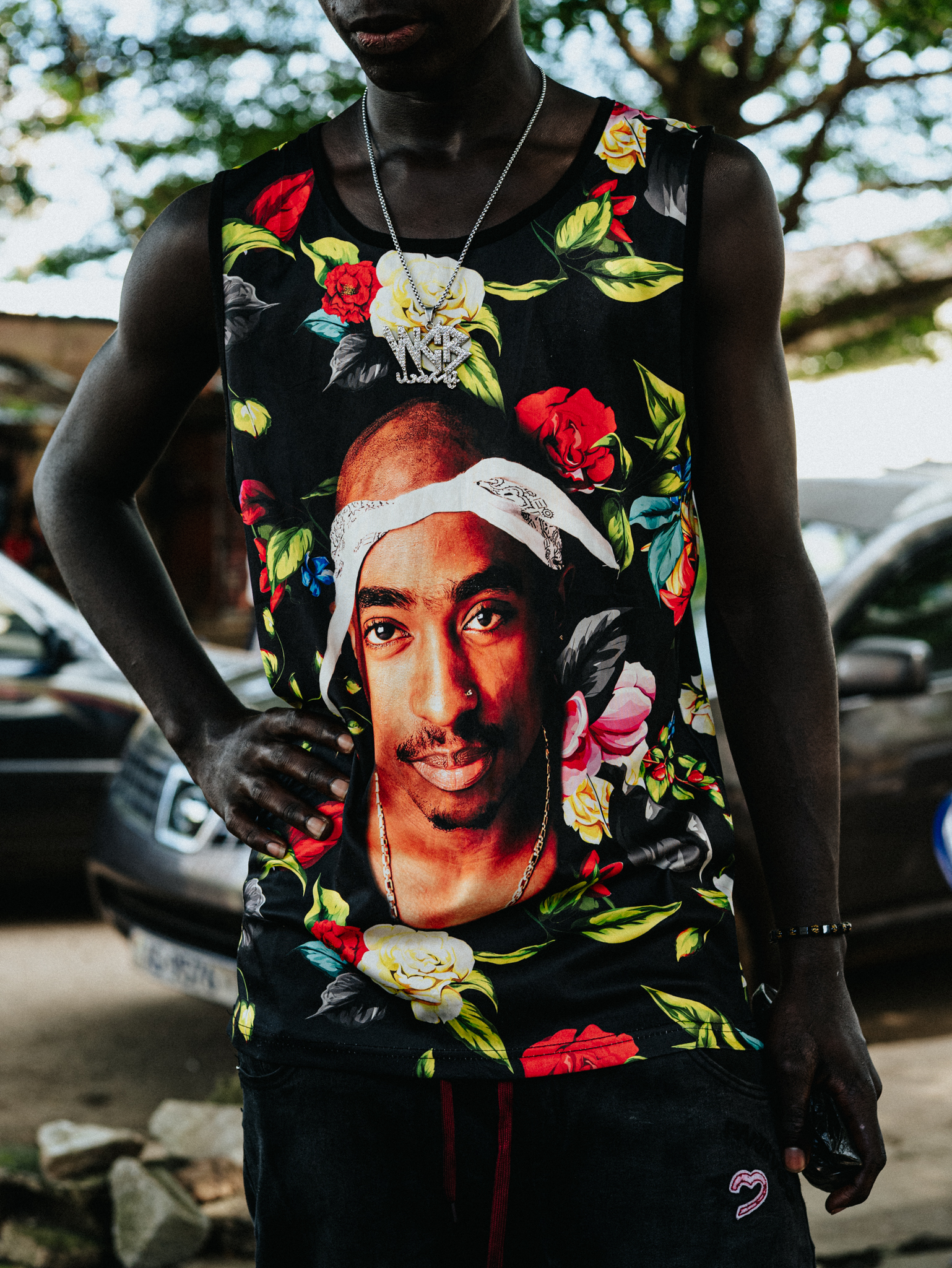
Toopaque. Photo: Courtesy of Aurélien Gillier.
The actual secret society of the Illuminati was founded in 1776 by Adam Weishaupt in Ingolstadt, apprehended in 1784 and then ceased to exist as an organization. However, it became famous as the alleged mastermind behind the French Revolution and as usurpers of the social and political order in the United States (Gregory, 2009; McKenzie-McHarg, 2014; Robison, 1798). Akin to the New World Order, the Jewish world conspiracy, and other ideas of all-encompassing domination, the Illuminati are thought to control and steer the major events of our time, while at the same time maintaining a facade of normality.
In Conakry, the Illuminati are generally described as a secret satanic sect of omnipotent and transnationally connected individuals. Their specific identity, their relationship to other groups such as the Freemasons, their involvement in day-to-day politics, and the question of who actually belongs to the Illuminati are controversial.[1]
Before the advent of the Internet, DVDs from neighboring Sierra Leone provided evidence that Bill Gates, Rihanna, Jay-Z, and Beyoncé were Illuminati; at the time, the president and several ministers were suspected of being national Illuminati. One interior minister apparently refused to say explicitly whether he was an Illuminati or not, playing on the mixture of mistrust and awe that surrounds this idea. At the regional level, Malian singer and kora player Sidiki Diabaté, son of kora legend Toumani Diabaté, was regularly questioned about his missing finger, as members were allegedly only accepted into the secret congregation through a kind of sacrifice, often in the form of a body part. Similar suspicions were directed at singer Maître Gims and the late DJ Arafat. However, the specific reasons behind these suspicions often remain vague. In some cases, reference is made to satanic symbols in music videos or combinations of numbers, but, at least in Conakry, there are hardly any concrete events that could be used to prove the Illuminati conspiracy.
Given how deeply Guinea’s history is marked by actual conspiracies, these pop-cultural narratives surrounding celebrities can appear disturbing. Guinea was the only French colony that voted NO in a 1958 referendum to break away from colonial rule instead of becoming part of the West African Communauté Française. Under President Sékou Touré, it became the target of French subversion, starting with the Opération Persil in January 1959 and France’s attempts to destabilize Guinea’s economy by introducing counterfeit banknotes to cause hyperinflation (Bat, 2008; Faligot & Krop, 1985; Goerg & Pauthier, forthcoming; Pierret & Correau, 2018). In November 1970, Portuguese troops marched into Conakry to capture Guinea-Bissau’s anti-colonial leader Amilcar Cabral and overthrow Sékou Touré as part of Operation Mar Verde (Marinho, 2021). Although none of these conspiracies were successful—Touré died of natural causes in 1984—they had a profound effect. The regime was permeated by the idea of a “Complot Permanent” (Lewin, 2009, p. 17), a constant neocolonial, imperialist conspiracy, a danger that also emanated from supposed accomplices and enemies within. Conspiracy theories thus became part of the regime’s institutionalized repertoire for suppressing, intimidating, imprisoning, torturing, and executing real and imagined opposition forces.
Compared to the former imperialist enemy, and contrary to the Manichean worldview that conspiracy theories are said to represent, the Illuminati in Conakry cannot be easily pinpointed and elude clear distinctions. They are not tied to specific locations. Although their power center is still believed to be in the global North, it is increasingly assumed that many Asians are now involved. The term is also remarkably vague in terms of identity characteristics such as gender, ethnicity, or nationality. Potentially, anyone can be an Illuminati, even among the stars that people admire. The enormous range of connotations associated with the Illuminati—evil, fame, money, power, secrecy, sacrifice, transnationalism—opens up a variety of attitudes toward them, from criticism to envy to admiration.
In fact, the aspiration to be part of the Illuminati is being increasingly exploited via the anonymity of social media in a thriving market of deception (see Newell, 2021). A friend of mine, let’s call him Abdoulaye, a rapper with a low-paying job as a substitute teacher, had been contacted via WhatsApp by a foreign profile claiming to be the Maître of an Illuminati lodge in Washington, D.C. The man assured Abdoulaye that he was chosen to be among the richest and most famous people in the world if he joined the Illuminati and followed all the rules with absolute discretion. This ultimately included sending his passport to a foreign address. Abdoulaye refused and broke off contact after two months, but he remained convinced that he had spoken to the real Illuminati and doubted for a long time afterwards whether he should have taken the leap of faith. Another friend told him: “If they [the Illuminati] can give you everything you want for ten years, I’d be willing to sell my soul. Then I can build my mother a villa and everything will be fine, then I can die.”
If we follow Achille Mbembe and Julie Archambault in their assessment, the ambivalence of the Illuminati is all but unique; it is “at the heart of contemporary processes of identity formation in the [African] continent” (Mbembe, 2002, p. 639) and characteristic of “regimes of truth that […] encourage ambiguation over clarification” (Archambault, 2017, p. 15). In such a regime, the Illuminati are not a clearly defined ontological object but a reference point for scepticism: What order is at work here? Who is part of this order? Is it open to me? The lack of clear answers reveals the “inherent fragility” of reality, as Boltanski (2011, p. 36) puts it—but without necessarily leading to existential fears of lack of control (cf. Bauman, 1997, p. xviii). Instead, a playful and ironic relationship with possible truths in the plural often prevails—Saïkou Oumar Sagnane speaks here of an ironic attitude of insouciance that Guineans muster to cope with the hardships of everyday life.[2]
Achille Mbembe (2002, p. 639) attributes it to the “heretical spirit” that lies at the heart of the encounter between Africa and the world, be it in relation to Islamic, Christian, and colonial regimes and knowledge orders.
Each time, reality is erased, recreated, and duplicated. It is this power of proliferation (and its ability to obliterate the notions of truth and falsehood, of the real and the unreal, of the visible and the occult) that characterizes contemporary African experience, which is at least original, if not unique. These characteristics are threefold: an absence of sharp ruptures, a nonlinearity, and everywhere the swirling chain of fragmented events in which everything else is engulfed (Mbembe, 2002, p. 640).
In the case of the Illuminati, the conspiracy theory of the “Illuminati” is turned into a metaphor for a Machiavellian system of money and power that is dramatized on the one hand, but on the other hand is also broken down and opened up, rendered accessible, and thus turned into its opposite. One may wonder whether the “African experience” is in fact so unique after all. The swirling chain of fragmented events seems to be at least one of the dynamics that the world is confronted with in the current post-truth condition. As Boltanski (2014, p. 202) writes about conspiracy theories as reconfigurations of reality: „Such reconfigurations may gradually come to affect the very tenor of reality as a whole, a reality that, paradoxically, tends to dissolve in the multiplicity of probing operations intended to make it hold together.“
,
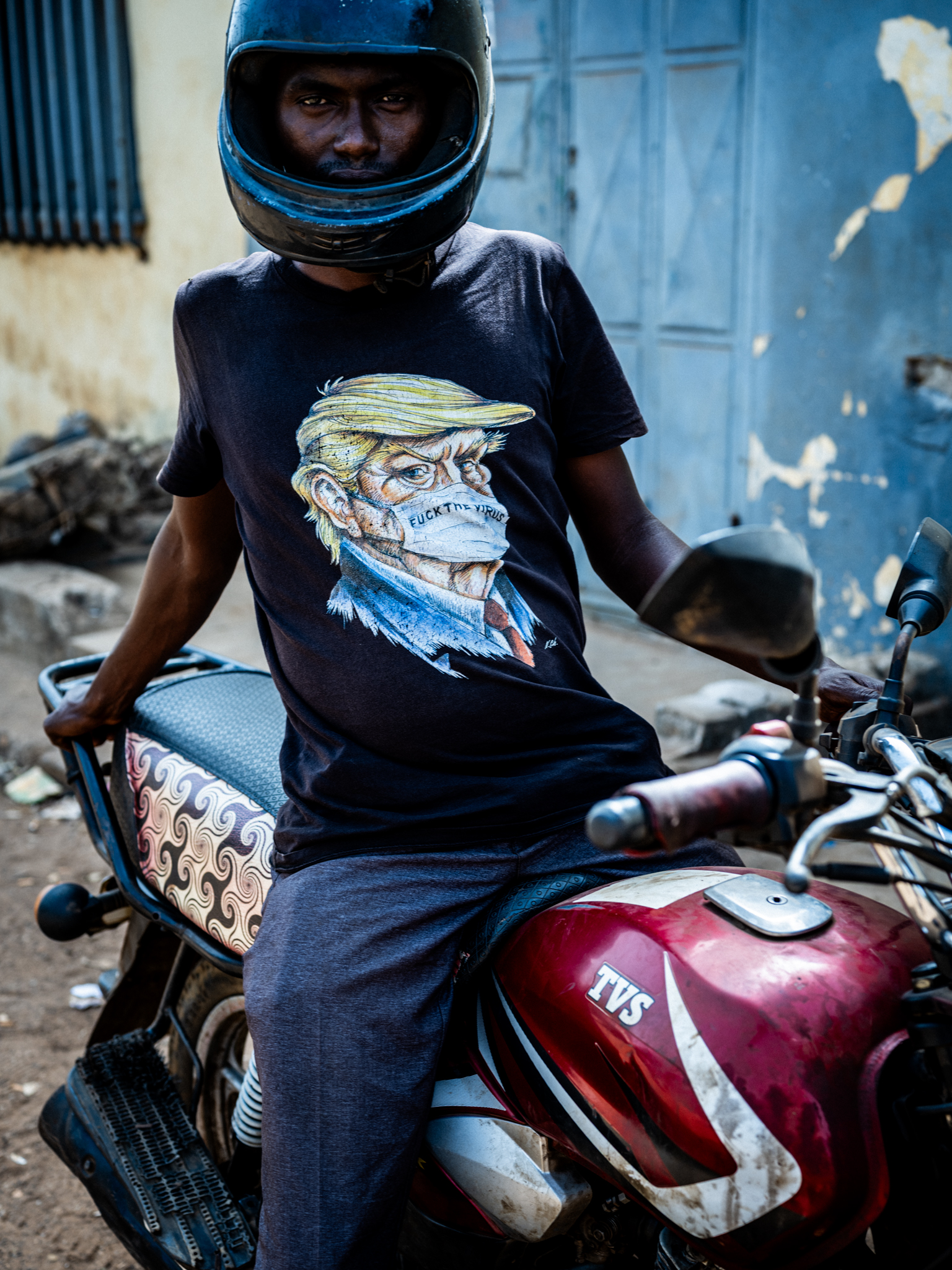
Fuck the Virus. Photo: Courtesy of Aurélien Gillier.
Stranger than fiction
As conspiracy theories and post-truth politics have emerged as “energizing points of attention and contention” (Collins, 1998, p. 876), they are increasingly used as a global frame of reference to analyse contemporary problems at the nexus between power and knowledge. Bespeaking the modern nation-state’s concern over informational hegemony (Alatas, 2022; Boltanski, 2014; Gramsci, 1988; Srivastava, 2012), the perspectives associated with these terms are now entering places where they have hitherto been hardly existant. In Guinea, for instance, NGOs and international organizations have increasingly campaigned against disinformation and rumors, against online hate speech and fake news. Whether these campaigns are helpful needs to be assessed on a case-to-case basis. What they certainly miss out on, however, is that reality is often so absurdly unjust and inequal, that some people rely on some metaphorical satanic sect to make sense of it.
Guinea, and perhaps I should have pointed this out before, is the world’s largest supplier of bauxite, the main ingredient of aluminium; it is also home to the world’s largest undeveloped, high-grade iron ore deposit, the Simandou mine (Campbell & Clapp, 1995; Knierzinger, 2018). At the same time, Guinea is one of the poorest countries in the world, and thus home to a what Guineans like to call a geological scandal that persists despite uncountable strikes and protests against both the mining companies and the state that protects them (Philipps, 2017; Sarró, 2023). In the “corruption deal of the century” surrounding the Simandou mine (Keefe, 2013; Kochan, 2013), the now-convicted Nicolas Sarkozy represented the currently indicted Israeli investor Beny Steinmetz. The annual profits of mining companies such as Rusal or Rio Tinto are in some cases ten times higher than Guinea’s budget; individual shareholders in these companies have private assets amounting to the annual income of all Guineans combined; singular investors, and even individual persons, can make decisions about the “fate of millions by telling their companies to stop the machines, without breaking any laws” (Knierzinger, 2014, p. 26). The absence of any organized high-level debate about these realities is arguably more problematic than the falsehoods that circulate.
What can global sociology do in such a context? For one, it can help contextualize and “provincialize” the post-truth problem. It can shape a more humble sociological stance by alerting us to the fact that “Northern theory” and its claims to universality (Connell, 2006) often stand in the way of a more lateral approach to universality (Diagne, 2023). It can be drawn upon to translate what concepts such as “conspiracy theories” mean in different spaces and places of the world, and to study how to re-conceptualize the phenomenon of believing in malevolent secret powers as the cause behind harmful events. Concepts, as Macamo (2022) reminds us, ultimately “hide more than they reveal,” and working at the interstices of what allows and evades conceptual capture (Simone, 2022) is necessary to do empirical qualitative research in a context where, as Kovats-Bernard put it, “the ‘stability in the ethnographic field’ once guaranteed by colonial power no longer holds” (cited in Andersson, 2016, p. 708). Such reservations, finally, do not mean that we need to dissociate ourselves from debates about post-truth and conspiracy theories. As ‘the West’ has ceased to be the world’s center of gravity (Comaroff & Comaroff, 2012; Connell, 2006, 2007; Mbembe, 2013, p. 1), the destabilization of hitherto dominant knowledge systems is very much part of what “post-truth” is about.
[1] The following notes are based on interviews and conversations in Conakry and over the phone since 2017, especially with Ams Keuche, Nana Barry and Fiston. Some of it stems from my previous work on Conakry’s urban youth (Philipps, 2013).
[2] Conversation with Saïkou Oumar Sagnane, Conakry, March 2022. See also Sagnane (2024).
Cite this article as: Philipps, J. (2026, February 5). Illuminati in Conakry: On post-truth, conspiracy theories, and the majority world. Global Qualitative Sociology Network. https://global-qualitative-sociology.net/2026/02/05/illuminati-in-conakry/
References
Bat, J.-P. (2008). Le syndrome Foccart: La politique française en Afrique, de 1959 à nos jours. Editions Gallimard.
Bauman, Z. (1997). Postmodernity and its discontents. Polity Press.
Boltanski, L. (2011). On critique: A sociology of emancipation. Polity Press.
Boltanski, L. (2014). Mysteries and conspiracies: Detective stories, spy novels and the making of modern societies. Polity Press.
Campbell, B., & Clapp, J. (1995). Guinea’s economic performance under structural adjustment: Importance of mining and agriculture. The Journal of Modern African Studies, 33(3), 425–449.
Cooper, E., & Pratten, D. (Eds). (2015). Ethnographies of uncertainty in Africa. Palgrave Macmillan.
Faligot, R., & Krop, P. (1985). La Piscine: Les services secrets français, 1944-1984. Editions du Seuil.
Goerg, O., & Pauthier, C. (2025). Aux origines de l’obsession complotiste en Guinée, années 1940–1961. In J. Philipps & A. Gillier (Eds), Politics of the unknown. Images of power and the power of images. iwalewabooks.
Gramsci, A. (1988). Gramsci’s prison letters: A selection. Swan.
Gregory, S. (2009). Wissen und Geheimnis: Das Experiment des Illuminatenordens. Stroemfeld.
Latour, B. (1987). Science in action: How to follow scientists and engineers through society. Harvard University Press.
Lewin, A. (2009). Ahmed Sékou Touré: (1922–1984): Président de la Guinée de 1958 à 1984. L’Harmattan.
Macamo, E. (2022, May 21). In search of an object: Producing knowledge on the global south. Doing global sociology: Methodology and theory after the postcolonial critique, University of Göttingen.
Marinho, A. L. (2021). Operação mar verde: Um documento para a história. Temas e Debates.
Mbembe, A. (2002). On the power of the false. Public Culture, 14(3), 629–641.
McKenzie-McHarg, A. (2014). The transfer of anti-Illuminati conspiracy theories to the United States in the late eighteenth century. In M. Butter & M. Reinkowski (Eds.), Conspiracy theories in the United States and the Middle East (pp. 231–250). De Gruyter.
Philipps, J. (2013). Ambivalent rage: Youth gangs and political protests in Conakry, Guinea. Éditions L’Harmattan.
Philipps, J., & Gillier, A. (2024). Modalities of theorizing. An interdisciplinary reflection on conspiracy theories. University of Bayreuth African Studies Online Series (BASOS).
Popper, K. R. (1962). Introduction: On the sources of knowledge and of ignorance. In Conjectures and refutations: The growth of scientific knowledge (pp. 3–32). Basic Books.
Robison, J. (1798). Proofs of a conspiracy against all the religions and governments of Europe, carried on in the secret meetings of Free Masons, Illuminati, and reading societies (4th ed.).
Veriava, A. (2025, July 8). Frank-Talking: Biko, Foucault, and the possibilities of telling the truth in a post truth world. 5th ISA Forum of Sociology, Rabat, Morocco.